By Qualitex Trading Technical Editorial Team | Japan Used Vehicle Export Insights
Over the last two decades, direct fuel injection (GDI) revolutionized automotive performance by spraying pressurized gasoline directly into the combustion chamber. This dramatically cooled intake charges, suppressed engine knock, and unlocked higher compression ratios. However, as first-generation direct-injection vehicles aged, mechanics and fleet operators worldwide uncovered a notorious systemic flaw: severe carbon accumulation along the back of the intake valves.
While many global manufacturers accepted periodic walnut blasting and intake valve chemical cleaning as inevitable maintenance costs, Toyota engineered an elegant mechanical workaround in 2005: D-4S (Direct-injection 4-stroke gasoline engine Superior version). By combining port fuel injection and direct cylinder injection into a single coordinated system, Toyota eliminated the classic weaknesses of pure direct injection. Here is a technical breakdown of how D-4S operates, how it compares to conventional direct injection systems, and what international buyers should evaluate when bidding on auction stock.
1. Technical Fuel Delivery Mechanics
Conventional Direct Injection (GDI / DIG / D-4 Early Spec)
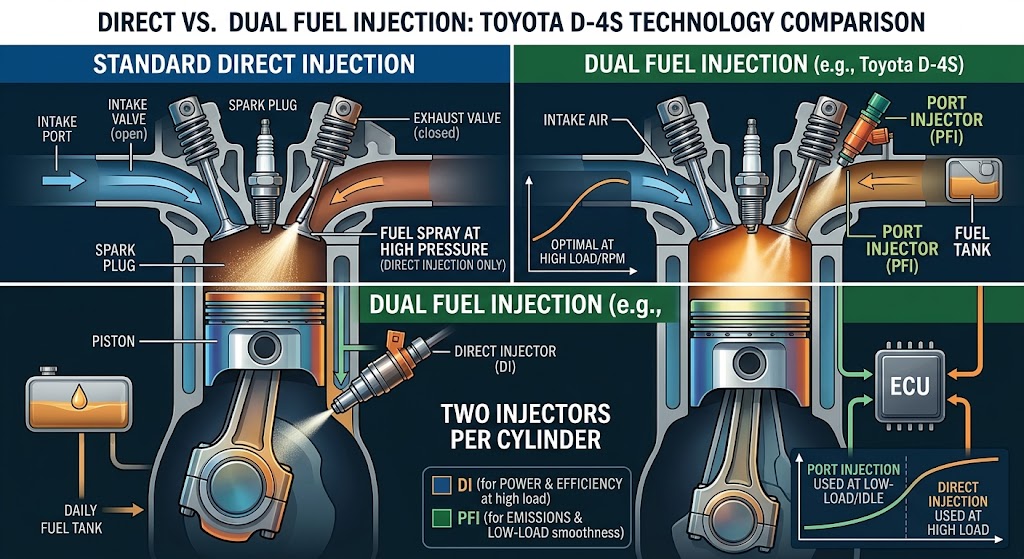
In a standard direct-injection gasoline engine, fuel is metered through a single high-pressure fuel rail running at 10 to 20 MPa (100 to 200 bar). Fuel injectors are threaded directly into the cylinder head, spraying atomized petrol straight into the combustion chamber next to the spark plug.
- The Thermodynamic Benefit: Fuel vaporizes inside the cylinder rather than in the intake runner. This phase change absorbs latent heat directly from the compressed air, lowering in-cylinder temperatures and enabling static compression ratios of 11.5:1 to 13.0:1 without causing pre-ignition knock.
- The Intake Valve Carbon Defect: In conventional port-injected engines, fuel sprays directly across the intake valve stems and ports, continuously washing away blow-by oil vapors vented by the positive crankcase ventilation (PCV) system. In pure direct-injection engines, fuel never touches the intake valves. Over 60,000 to 100,000 km, oil mists bake onto hot intake valves, forming dense carbon crusts that choke airflow, reduce power output, and induce intermittent cold-start misfires.
- Particulate Emissions: Under low-load cold-start conditions, direct-injected fuel droplets can hit cold cylinder walls and piston crowns (fuel impingement), leading to incomplete combustion and high particulate matter emissions.
Toyota D-4S: The Synchronized Dual-Injection Architecture
Developed on the 2GR-FSE 3.5L V6 (debuting in the Lexus GS and Crown Athlete) and later popularized globally on the FA20/FA24 boxer (Toyota 86/GR86 and Subaru BRZ) as well as the Dynamic Force A25A/M20A engine families, D-4S employs two separate injectors per cylinder: one port injector in the intake runner and one direct injector inside the cylinder head.
- Low-Load & Idle Operation (Dual / Split Injection): At low engine speeds and light throttle loads, intake air velocity is low. Fuel atomization from direct injectors can be sub-optimal. D-4S primarily uses the low-pressure port injectors (supplemented by a minor direct injection pulse). This creates a homogeneous, thoroughly mixed charge for smooth idling and minimal emissions while continuously washing the intake valves with fresh detergent-rich gasoline.
- Mid-Range Load (Dynamic Blending): As vehicle load increases, the engine control module dynamically balances the ratio between port and direct injection (such as 40:60 or 50:50). This maximizes volumetric efficiency, prevents hot spots, and delivers smooth, linear mid-band torque.
- High-Load & Full Throttle (100% Direct Injection): Under wide-open throttle (WOT) and high RPM, the port injectors shut off completely. The high-pressure direct injectors spray 100% of the fuel charge (at pressures exceeding 20 MPa via specialized slotted multi-hole nozzles). The in-cylinder vaporization charge cooling prevents high-RPM detonation, enabling maximum horsepower extraction from high static compression designs.
2. Engineering & Technical Comparison Matrix
| Drivetrain Attribute | Standard Direct Injection (GDI / DIG) | Toyota D-4S Dual Injection |
|---|---|---|
| Injectors per Cylinder | 1 High-Pressure Direct Injector | 2 Injectors (1 Port Low-Pressure + 1 Direct High-Pressure) |
| Fuel Rail Systems | 1 High-Pressure Rail (Cam-driven pump) | Dual Rails: Low-Pressure (~0.4 MPa) + High-Pressure (~20 MPa) |
| Intake Valve Carbon Wash | None (Intake valves suffer progressive carbon baking) | Continuous (Port injectors clean intake valves during low/mid load) |
| Cold-Start Emissions & Soot | Higher particulate count; prone to wall wetting | Significantly reduced via port injection homogenization |
| Top-End Volumetric Efficiency | High | Class-Leading (Combines runner scavenging with direct cooling) |
| Mechanical Part Count & ECU Logic | Lower complexity, standard single-rail mapping | High complexity (Dual fuel pumps, 8–12 injectors, dual-map ECU) |
| Popular Export Auction Models | Nissan Serena (MR20DD), Mazda CX-5 (Skyactiv-G), Stepwgn (L15B) | Crown Athlete (GRS204/214), Harrier (MXUA80), Toyota 86 (ZN6/ZN8) |
3. Auction Inspection & Destination Market Serviceability
1. Cold-Start Ticking vs. Direct Injection Pump Normalcy
When inspecting D-4S equipped vehicles (such as a 3.5L Lexus IS350 or Toyota Crown Athlete) in auction staging yards, international buyers often express alarm at a pronounced mechanical clicking or “ticking” noise at idle. In 95% of cases, this is not valvetrain or lifter failure. The high-pressure mechanical fuel pump (driven off the camshaft lobe) and the direct injector solenoids emit a sharp acoustic signature. As the ECU cycles between port and direct injection during cold-start catalyst heating, this sound modulates naturally.
2. Intake Valve Sludge on Single-Injection Competitors
If you are bidding on vehicles featuring pure direct injection (such as Nissan MR20DD engines in the C26/C27 Serena or early direct-injected European imports from Japan), pay close attention to idle stability and acceleration smoothness on auction report sheets. Engines that spent years doing low-speed grocery runs in Tokyo traffic often exhibit hesitations caused by severe intake runner carbon buildup. If purchased, budget for physical walnut-shell blasting of the intake ports upon arrival at your port workshop.
3. Low-Pressure and High-Pressure Fuel Filter Maintenance
Because Toyota D-4S utilizes two distinct fuel pressure circuits, fuel cleanliness is paramount in export destinations where fuel storage facilities may contain sediment or water contamination. The in-tank fuel filter feeds the standard low-pressure pump, which subsequently feeds both the port injectors and the cam-driven high-pressure mechanical pump. If fuel supply pressure drops, the ECU will limit maximum engine load and disable high-cam or direct-injection operation to safeguard the fuel pump from cavitation.
Frequently Asked Questions (FAQ)
1. Do Toyota D-4S engines ever require manual intake valve carbon cleaning?
Under normal operational conditions, no. Because the low-pressure port injectors routinely deliver fuel across the intake valves during idling, warm-up, and city cruising, fuel detergents continuously dissolve PCV oil vapors. D-4S engines routinely surpass 200,000 to 300,000 kilometers with spotless intake valve guides and runners.
2. What is the difference between Toyota D-4 and D-4S?
The original “D-4” system (introduced in the late 1990s on engines like the 3S-FSE and 1AZ-FSE) was a single direct-injection system without port injectors. It suffered from the same carbon accumulation and cold-start carbon fouling issues as early European and American direct-injection platforms. The addition of the “S” designation (Superior) marked the introduction of the dual-injector (port plus direct) layout on the 2GR-FSE in 2005.
3. How do aftermarket tuners handle D-4S on platforms like the Toyota 86 and GR86?
Dual injection is highly valued by performance tuners. When adding aftermarket turbochargers or superchargers, single direct-injection systems often run out of injector pulse window at high RPM. On D-4S platforms, tuners can simply upgrade the readily accessible low-pressure port injectors to larger flow capacities (e.g., 700cc–1000cc) to provide supplemental fueling without needing exotic high-pressure direct injector retrofits.
4. Can D-4S vehicles run on lower-octane pump fuel in emerging markets?
Naturally aspirated D-4S performance engines (like the 2GR-FSE or FA20) run high static compression ratios of 11.8:1 to 12.5:1 and require high-octane gasoline (minimum 95 RON) for optimal operation. Running low-octane fuel forces the ECU to aggressively retard ignition timing, degrading fuel efficiency and throttle response. For newer Dynamic Force engines (A25A/M20A) in the RAV4, Camry, and Harrier, Toyota revised the intake port angle and combustion chamber geometries to safely accommodate standard commercial fuel grades worldwide.
Source Reliable Toyota D-4S & JDM Stock Direct from Japan
At Qualitex Trading Co. Ltd, our technical team verifies engine codes, chassis variants, and maintenance logbooks across every major auto auction house in Japan. Whether you are sourcing clean Lexus sedans, robust Toyota RAV4/Harrier SUVs, or sporty Toyota 86 coupes, partner with Qualitex Trading for expert auction bidding, strict pre-export condition checks, and worldwide port delivery.
Ready to Import Your Next Vehicle?
Qualitex Trading Japan provides direct access to over 100,000+ Japanese used cars at auction prices. We handle bidding, inspection, and global shipping.