By Qualitex Trading Technical Editorial Team | Japan Used Vehicle Export Insights
As global emissions targets tightened over the past decade, most international automakers simply downsized engine displacements and added small turbochargers. Japan’s two most ambitious powertrain innovators, Mazda and Nissan, rejected this simplistic compromise. Instead, they tackled the holy grail of internal combustion thermodynamics: dynamic in-cylinder compression management.
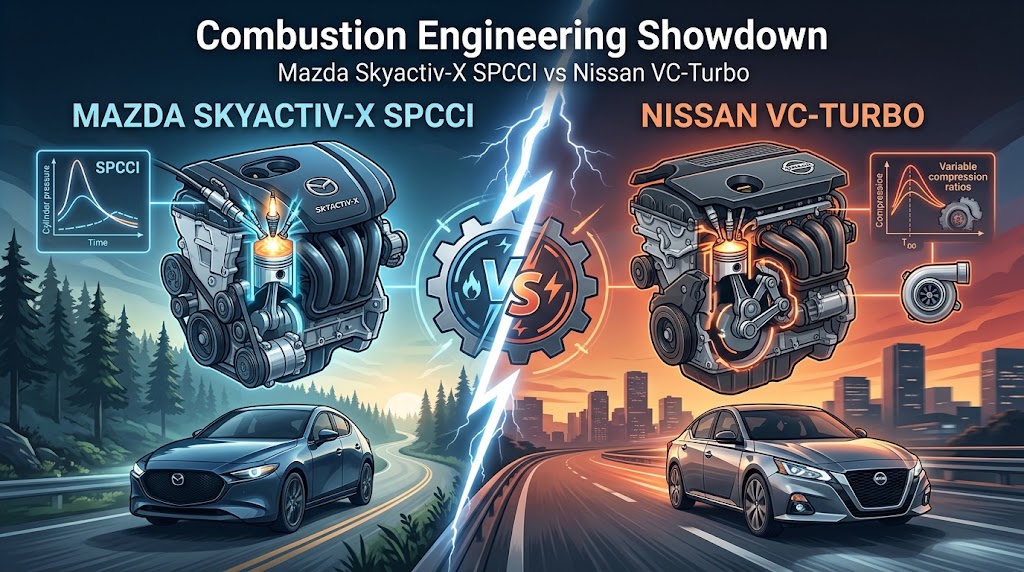
Mazda conquered the combustion process chemically and thermodynamically using Spark Controlled Compression Ignition (SPCCI) in its Skyactiv-X engine. Nissan took an intricate electromechanical path, designing the world’s first production Variable Compression Turbo (VC-Turbo) multi-link engine. For automotive dealers, importers, and workshop managers bidding on Japanese auction stock, understanding how these radical engines work—and how they must be serviced in destination ports—is critical to protecting your investment.
1. Technical Engineering Principles
Mazda Skyactiv-X: Spark Controlled Compression Ignition (SPCCI)
Automotive engineers have spent decades trying to build a gasoline engine running on Homogeneous Charge Compression Ignition (HCCI)—igniting a petrol-air mixture via compression heat alone, like a diesel engine. While HCCI yields remarkable thermal efficiency and low emissions, controlling the exact millisecond of spontaneous self-ignition across varying ambient air temperatures and driving loads proved nearly impossible in mass production.
Mazda solved this with SPCCI by using the spark plug not just as an igniter, but as an expansion control piston:
- Split High-Pressure Direct Injection: During the intake stroke, an ultra-lean air-fuel mixture (lambda ≥ 2.0, reaching 30:1 to 40:1 air-to-fuel ratio) is introduced into the cylinder, assisted by a small Roots-type electric supercharger that acts as a high-volume air supply mechanism.
- The Spark “Air Piston”: During the compression stroke, a second micro-dose of fuel is sprayed directly around the tip of the spark plug to form a small, localized stoichiometric pocket. The spark plug ignites this richer core. As the flame kernel expands rapidly, it acts as a secondary “air piston,” violently spiking pressure and temperature in the remaining combustion chamber.
- Compression Ignition: This artificial pressure spike forces the surrounding ultra-lean bulk mixture to spontaneously self-ignite simultaneously throughout the cylinder. The result is a fast, clean burn at lower flame temperatures, drastically cutting thermal losses and nitrogen oxide (NOx) output.
Nissan VC-Turbo: Electro-Mechanical Variable Compression Geometry
Every traditional gasoline engine operates with a fixed physical compression ratio. A high compression ratio (e.g., 14.0:1) optimizes thermal efficiency during low-load highway cruising, but causes catastrophic pre-ignition “engine knock” under turbo boost. A low compression ratio (e.g., 8.0:1) safely tolerates heavy boost pressure, but wastes fuel when cruising off-boost.
Nissan eliminated this compromise through a multi-link connecting rod mechanism inside its KR20DDET (2.0L 4-cylinder) and KR15DDT (1.5L 3-cylinder) engines:
- The Multi-Link Assembly: Instead of attaching traditional connecting rods directly to the crankshaft journal, the piston connects to an intermediate lower link. This lower link is mounted on an eccentric control shaft linked to an electric Harmonic Drive reduction actuator motor.
- Real-Time Stroke Adjustment: When you cruise at light throttle, the actuator tilts the control shaft, pulling the multi-link assembly to raise the piston’s Top Dead Center (TDC). The compression ratio climbs continuously up to 14.0:1 for diesel-like highway efficiency.
- Instant Boost Drop: The millisecond the driver kicks the throttle down to overtake, the electric actuator shifts the control shaft in reverse, lowering piston TDC. The compression ratio drops instantly to 8.0:1, allowing the turbocharger to dump maximum boost into the combustion chamber without inducing knock.
2. Engineering & Specification Comparison Matrix
| Engineering Metric | Mazda Skyactiv-X (SPCCI) | Nissan VC-Turbo (Multi-Link) |
|---|---|---|
| Operating Philosophy | Thermodynamic & Combustion Chemistry (Lean-Burn) | Mechanical Variable Geometry (Reciprocating Kinematics) |
| Effective Compression Range | Static 15.0:1 (Euro/JDM) / 16.3:1 (Early spec) | Continuously Variable from 8.0:1 to 14.0:1 |
| Air Intake & Induction | Naturally aspirated + Small belt-driven air supply pump | Single-scroll / Twin-scroll Turbocharger + Intercooler |
| Fuel Injection System | Central Direct Injection (Ultra-high 70 MPa / 700 bar) | Dual Injection: MPI (Port) + GDI (Direct) |
| Cylinder Pressure Monitoring | In-cylinder pressure sensor on every individual cylinder | Standard external knock sensors & crank position sensors |
| Primary Failure / Wear Point | Spark plug fouling, sensor carbon buildup, supercharger clutch | Lower-link bearings, harmonic actuator motor, oil aeration |
| Popular JDM Export Models | Mazda3 (BPFJX), CX-30 (DMFP) | X-Trail (T33 e-POWER), Altima, Infiniti QX50 / QX55 |
3. Auction Inspection & Destination Market Serviceability
1. Mazda Skyactiv-X: Spark Plug & In-Cylinder Sensor Sensitivity
The SPCCI engine relies on in-cylinder pressure sensors integrated directly into each cylinder head channel to monitor combustion pressure thousands of times per second. Because the engine operates in ultra-lean mode, using non-OEM or standard spark plugs is disastrous. These engines require dedicated, specialized iridium/platinum long-reach plugs (such as OEM NGK units) capable of surviving extreme combustion chamber heat. If an auction vehicle from Tokyo or Osaka has suffered extended low-speed idling, check for rough cold-start hesitation or P0300 misfire codes caused by electrode carbon fouling.
2. Nissan VC-Turbo: Lubrication Rigor & Bearing Clearances
The mechanical complexity of Nissan’s VC-Turbo is astonishing: each cylinder features additional pivot pins, lower multi-links, and eccentric bearing journals compared to a standard engine. This multiplies the number of high-load friction surfaces inside the crankcase. If previous owners in Japan stretched oil change intervals beyond 5,000 km, or used improper oil viscosities, bearing journals can experience accelerated wear. When inspecting KR20DDET or KR15DDT auction stock, listen carefully for bottom-end metallic tapping under light throttle transitions, and verify oil maintenance records on auction inspection sheets.
3. Fuel Quality Realities in Emerging Markets
Both engines are calibrated for high-quality, high-octane Japanese commercial fuels:
- Mazda Skyactiv-X: Operates at its peak efficiency on 95 to 98 RON premium fuel. Running it on low-octane 90–91 RON regular fuel in export markets forces the ECU to revert out of SPCCI mode into standard spark ignition, noticeably reducing fuel economy.
- Nissan VC-Turbo: Can adapt more flexibly to lower fuel octane by mechanically locking the compression ratio closer to 8.0:1 or 10.0:1 via its actuator. However, running lower octane permanently causes the engine to sacrifice its high-efficiency 14.0:1 Atkinson cruise mode, defeating the purpose of the engine.
Frequently Asked Questions (FAQ)
1. Does the Mazda Skyactiv-X use a diesel particulate filter (DPF)?
No. Even though it utilizes compression ignition principles similar to diesel, it burns standard gasoline and produces very low soot. However, European- and Japanese-spec models do include a Gasoline Particulate Filter (GPF) integrated into the exhaust system to capture trace particulates during cold-start operation.
2. Is the Nissan VC-Turbo reliable for long-term fleet use in Africa or the Caribbean?
While the VC-Turbo is a masterpiece of Japanese kinematics, it is a high-precision, low-tolerance powertrain. For markets with high dust contamination, questionable fuel octane levels, or workshops lacking advanced bidirectional diagnostic scanners, traditional naturally aspirated engines (like Toyota’s 2AR-FE or Nissan’s QR25DE) remain safer volume fleet choices. Importers bringing in VC-Turbo models must strictly educate customers on full-synthetic 0W-20 oil usage and short service intervals.
3. Why does the Mazda Skyactiv-X have a supercharger if it isn’t sold as a turbo sports car?
Mazda does not use the Roots-type supercharger to create high boost pressure for peak horsepower. Instead, Mazda labels it an “air supply pump.” Its sole engineering function is to ram large masses of lean air into the combustion chamber to maintain the 30:1 to 40:1 lean air-fuel ratio required for SPCCI operation.
4. How do I confirm if a Mazda3 at auction has the Skyactiv-X engine?
Look at the Japanese auction sheet chassis prefix and vehicle classification. The standard 2.0L gasoline model is chassis code BP5P (1.5L) or BPFP (2.0L Skyactiv-G). The Skyactiv-X SPCCI model is designated under chassis code BPFJX. In the engine bay, Skyactiv-X features a distinctive insulated encapsulation cover, high-pressure fuel rails running centrally down the head, and secondary air piping for the electric supercharger.
Source Next-Generation JDM Vehicles with Confidence
At Qualitex Trading Co. Ltd, our experienced inspectors analyze vehicle condition sheets, check maintenance logbooks, and test onboard diagnostics directly at auction yards across Japan. Whether you are importing cutting-edge Mazda Skyactiv models or luxury Nissan and Infiniti SUVs, partner with Qualitex Trading for verified sourcing, transparent bidding, and secure global logistics.
Ready to Import Your Next Vehicle?
Qualitex Trading Japan provides direct access to over 100,000+ Japanese used cars at auction prices. We handle bidding, inspection, and global shipping.