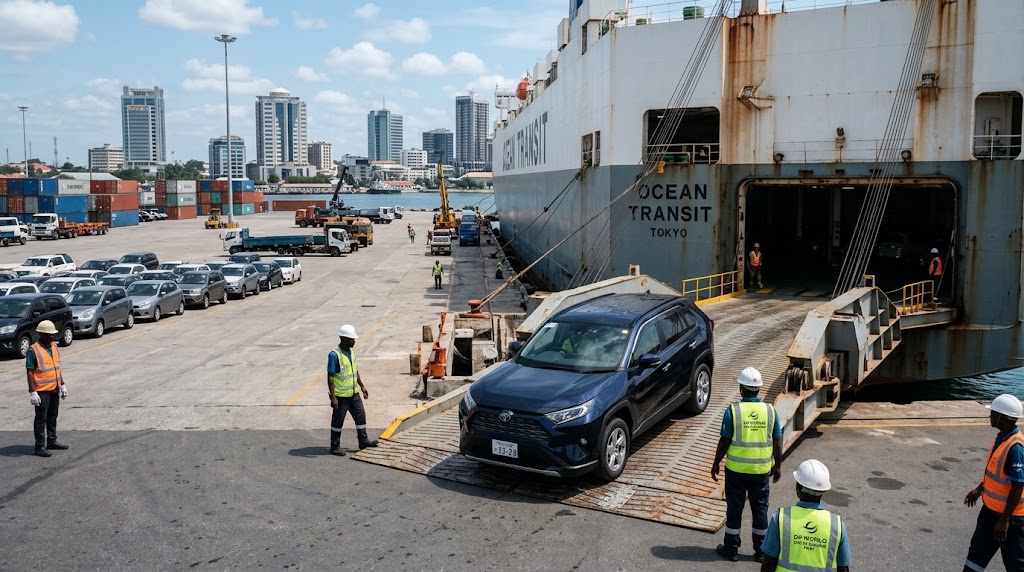
Short answer: yes. We found no age ban in the Tanzanian documents we read, but Tanzania charges more excise duty the older a car is, and it raised those rates on 1 July 2026. A used car from Japan must also carry a Certificate of Roadworthiness from the inspection company contracted by the Tanzania Bureau of Standards (TBS), which names EAA Company Limited for Japan. Without it the car is inspected on arrival and a penalty of 15% of the invoice value applies. We checked the points below against TBS, the Tanzania Revenue Authority (TRA), press reports on the Finance Act 2026 and the Embassy of Japan on 2 November 2026. We could not confirm the import duty rate for cars from a TRA page, so this guide gives the taxes we could source and says what is missing.
Key points (checked 2 November 2026)
- Inspection: TBS says used vehicles under its pre-shipment programme must obtain a Certificate of Roadworthiness, valid for three months, and that EAA Company Limited is contracted to inspect used vehicles from Japan and the United Kingdom.
- Penalty: a used vehicle without the certificate faces destination inspection and a penalty of 15% of its invoice value, as assessed by TRA. A vehicle that fails must be repaired and reinspected within 21 days, or returned or destroyed at the importer’s expense.
- Age and excise: from 1 July 2026, reports put excise at 18% for a car aged over 8 up to 10 years, 35% for over 10 up to 20 years, and 40% for over 20 years. TRA’s guide for 2025/26 had 15% and 30% for the first two bands.
- Other taxes: VAT of 18% on imports and a Railway Development Levy of 2% of the CIF value, according to TRA’s 2025/26 guide.
- Fraud: the Embassy of Japan in Tanzania urges importers to contact JETRO before dealing with a Japanese seller.
Step 1: the pre-shipment inspection
TBS runs a Pre-shipment Verification of Conformity (PVoC) programme. Its guideline says all consignments subject to PVoC must obtain a Certificate of Conformity or Certificate of Roadworthiness, “without which the commodities arriving at Tanzanian Ports will be rejected or fined.” For used vehicles, the guideline says EAA Company Limited has been contracted to inspect used motor vehicles from Japan and the United Kingdom, Quality Inspection Services Inc. Japan (QISJ) inspects in Dubai, and the China Certification and Inspection Group inspects in China, Macau, Hong Kong and Taiwan.
- Validity: the guideline says the certificate is valid for three months from the date of issue, and that TBS may reject a consignment if it is found non-conforming at the port.
- At the port: TBS’s procedure for used vehicles says the importer or clearing agent submits the original inspection certificate, the inspection sheet, the bill of lading, and the commercial invoice to TBS through the single window system for authentication. The authenticated certificate is then used to clear the car at the point of entry.
- Without a certificate: a TBS notice says a used vehicle imported without a certificate from a country where PVoC applies is subject to destination inspection with a penalty of 15% of the total invoice value of the vehicle, as assessed by TRA. If it fails the inspection at the destination, the importer must repair it and present it for re-inspection within 21 days. A vehicle that cannot be repaired is returned to the country of export or destroyed at the importer’s expense.
The guideline’s fee table covers PVoC goods in general. We found no TBS page that states a fee for a used vehicle, so ask your exporter what the inspection costs.
Step 2: age and excise duty
We found no age limit that bars a car from entering Tanzania in the TBS and TRA documents. What the sources show is a duty that rises with age, and the rates changed from 1 July 2026.
| Age of the car (passenger vehicles under 10 seats) | TRA guide, July 2025 | Finance Act 2026, from 1 July 2026 |
|---|---|---|
| Up to 8 years | No age-based excise listed | No age-based rate reported |
| Over 8 up to 10 years | 15% | 18% |
| Over 10 up to 20 years | 30% (over 10 years) | 35% |
| Over 20 years | 30% (over 10 years) | 40% |
The 2026 figures come from The Citizen, which reported that Parliament cut the 8-to-10-year rate from 20% in the Finance Bill to 18%, and from Clyde & Co’s summary of the Act. We did not read the Act itself.
Excise also depends on engine size. TRA’s 2025/26 guide lists 0% for cylinder capacity under 1,000cc, 5% from 1,000cc to 2,000cc and 10% above 2,000cc, including hybrids. The Citizen reported that from 1 July 2026 cars up to 1,000cc, previously exempt, are taxed at 5%. A Tanzania Revenue Authority presentation says the age-based excise is charged in addition to the excise based on engine size, so an older car can pay both. Ask for a TRA assessment for your exact car to see the combined figure.
Step 3: other taxes
| Tax | What the TRA guide for 2025/26 says |
|---|---|
| VAT | 18% on the importation of taxable goods into Mainland Tanzania. Zanzibar has its own rates |
| Railway Development Levy | 2% of the customs value (CIF) of goods entered for home consumption in Mainland Tanzania |
| Import duty | The guide lists bands of 0%, 10%, 25% and 35% by type of goods and says some sensitive items are charged more than 25%. It gives no separate rate for cars, so we give none |
Ask your clearing agent for a written TRA assessment of the exact car, with the date of the rates, before you buy. A dealer quoted by The Citizen said import taxes would go up and that some financing arrangements require a 50% deposit.
A warning from the Embassy of Japan
The Embassy of Japan in Tanzania, with JETRO Nairobi, urged importers on 9 March 2022 to contact JETRO before dealing with a Japanese seller. It said some importers are lured by low prices and send money without confirming that the seller is reliable, and that money sent to fraudsters cannot be recovered. It said JETRO holds a list of genuine registered companies in Japan that export used vehicles.
Before you buy: a checklist
- The certificate: the seller will obtain a Certificate of Roadworthiness from the inspection company TBS contracts for Japan, within three months before the car arrives.
- The age: the car’s year of manufacture, so you know which excise band applies after 1 July 2026.
- Engine size: the cylinder capacity, which also sets an excise rate.
- Cost: a written TRA assessment for the exact car, with the date of the rates and any import duty.
- The seller: that the exporter is a genuine registered company, before you send any money.
- The documents: the bill of lading, the commercial invoice and anything else your clearing agent asks for.
More on importing a Japanese car
Read our guide to reading a Japanese auction sheet before you bid.
Frequently asked questions
Is there an age limit for used cars in Tanzania?
We found none in the TBS and TRA documents we read. Older cars pay more excise duty: from 1 July 2026, reports give 18%, 35% and 40% for cars over 8, over 10 and over 20 years old.
Do I need an inspection before the car ships?
Yes. TBS requires a Certificate of Roadworthiness from its contracted inspection company, which it names as EAA Company Limited for Japan. The certificate is valid for three months.
What happens if the car has no certificate?
It faces destination inspection and a penalty of 15% of its invoice value, as assessed by TRA. If it fails, it must be repaired and re-inspected within 21 days, or returned or destroyed at the importer’s expense.
How much tax will I pay?
We found no complete figure we can verify. Excise depends on the car’s age and engine size, VAT on imports is 18%, and the Railway Development Levy is 2% of the CIF value. We found no car-specific import duty rate, so ask your clearing agent for a TRA assessment.
Did the rules change in July 2026?
Yes. Reports on the Finance Act 2026 say excise on older used cars rose from 1 July 2026, and that cars up to 1,000cc are now taxed at 5% excise.
How long does it take?
We found no official timing, so we do not give one.
Last checked 2 November 2026
We wrote this guide from the Tanzanian and press sources listed below on 2 November 2026. We did not read the Finance Act 2026 itself, and we found no car-specific import duty rate or a TBS fee for used vehicles. Tanzania changes these rules each July, so check them again before you ship.
Sources
- Tanzania Bureau of Standards, Guideline for the Pre-shipment Verification of Conformity to Standards (PVoC) programme (2025)
- Tanzania Bureau of Standards, Applicable penalty for uninspected used motor vehicles under the PVoC programme (2025)
- Tanzania Revenue Authority, Taxes and duties at a glance 2025/2026
- The Citizen, Importing a used car now costs more as Finance Act takes effect, 1 July 2026
- Clyde & Co, Tanzania tax update: Finance Act 2026 highlights, July 2026
- Embassy of Japan in Tanzania, Notice to all importers of used motor vehicles from Japan, 9 March 2022
Ready to Import Your Next Vehicle?
Qualitex Trading Japan provides direct access to over 100,000+ Japanese used cars at auction prices. We handle bidding, inspection, and global shipping.