By Qualitex Trading Technical Editorial Team | Japan Used Vehicle Export Insights
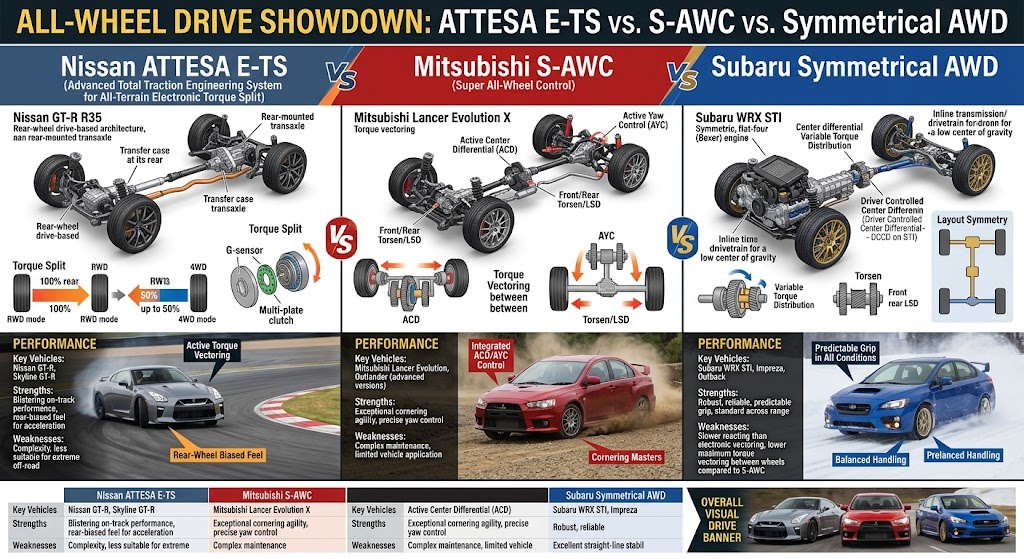
All-wheel drive (AWD) is one of the most requested driveline options among international buyers sourcing used vehicles from Japanese auto auctions. However, “AWD” is not a uniform specification in Japan. The engineering philosophies developed by Nissan, Mitsubishi, and Subaru represent three completely distinct mechanical approaches to solving traction, cornering rotation, and chassis dynamics.
Whether you are importing a classic performance icon like the Skyline GT-R or Lancer Evolution, or sourcing daily workhorses and crossovers like the Subaru Forester, Outback, or Mitsubishi Outlander, understanding how these systems operate is vital. Here is a technical breakdown of how Nissan ATTESA E-TS, Mitsubishi S-AWC, and Subaru Symmetrical AWD work, how they perform across different terrains, and what buyers must look for during auction inspection.
1. Core Mechanical Layouts & Operating Principles
Nissan ATTESA E-TS: The Rear-Biased Dynamic Torque Splitter
Introduced on the legendary R32 Skyline GT-R and refined through the R34 and R35 platforms, ATTESA E-TS (Advanced Total Traction Engineering System for All-Terrain – Electronic Torque Split) was designed with a single priority: preserving pure rear-wheel drive (RWD) agility while using front-axle traction to pull the chassis out of corner exits.
- Mechanical Architecture: The engine is mounted longitudinally, delivering 100% of torque directly to the rear wheels via a conventional propshaft under normal driving conditions. Inside the transfer case sits an electro-hydraulically controlled wet multi-plate clutch pack.
- Torque Vectoring Logic: A dedicated 16-bit/32-bit ECU continuously monitors wheel speed sensors, throttle position, and lateral/longitudinal G-sensors. The instant rear slip or high lateral load is detected, hydraulic pressure clamps the multi-plate clutch, transferring from 0% up to 50% of drive torque forward to the front differential.
- Driving Feel: Zero understeer on corner entry. The car turns in like a pure RWD vehicle, and the moment the driver applies power at the apex, the front wheels engage to stabilize the tail and slingshot the car forward.
Mitsubishi S-AWC: Active Yaw Rotation Authority
Developed on the rally stages of the WRC and perfected across the Lancer Evolution IV through X, S-AWC (Super All-Wheel Control) approaches all-wheel drive from an active vehicle dynamics standpoint. Rather than waiting for wheels to slip, S-AWC uses torque to physically force the chassis to rotate into corners.
- Mechanical Architecture: High-performance iterations combine an Active Center Differential (ACD) with an electronically controlled multi-plate clutch that varies front-to-rear torque split, alongside an Active Yaw Control (AYC) rear differential. Modern SUV versions (like the Outlander) adapt this logic using twin electric motors (PHEV) or electronic brake-vectoring.
- The AYC Advantage: Unlike standard limited-slip differentials that only lock axles together, AYC incorporates two planetary gearsets and hydraulic clutch packs. It actively overspeeds the outside rear wheel during hard cornering, generating a direct yaw moment that eliminates front-heavy transverse understeer.
- Driving Feel: Defies traditional chassis physics. Drivers can apply aggressive throttle mid-corner, and instead of pushing wide, the rear differential pivots the vehicle tightly around the apex.
Subaru Symmetrical AWD: Continuous Linear Balance
Subaru’s signature drivetrain is built around mechanical symmetry and a low center of gravity. Every component—from the horizontally opposed Boxer engine to the transmission, center differential, and driveshafts—sits in a straight, mirrored line along the vehicle’s longitudinal axis.
- Mechanical Architecture: Because half-shaft lengths are identical on both the left and right sides of each axle, Subaru vehicles suffer from virtually zero torque steer under hard acceleration. Center differential designs vary by transmission:
- Active Torque Split (ACT-4): Used in volume Lineartronic CVTs (Forester, XV/Crosstrek), utilizing an electronically managed wet multi-plate clutch running a baseline 60:40 front-to-rear split.
- Variable Torque Distribution (VTD): Paired with high-torque gearboxes, using a planetary center diff running a 45:55 rear-biased baseline.
- Driver Controlled Center Differential (DCCD): Found in WRX STI models, combining a mechanical planetary differential (41:59 split) with an electromagnetic multi-plate clutch that allows the driver to adjust center differential lock-up manually or automatically.
- Driving Feel: Unshakeable, predictable mechanical grip. It provides exceptional composure across unpaved washboard roads, deep mud, gravel, and snow.
2. Engineering & Export Comparison Matrix
| Attribute | Nissan ATTESA E-TS | Mitsubishi S-AWC (Mechanical) | Subaru Symmetrical AWD (DCCD / Continuous) |
|---|---|---|---|
| Primary Layout | Longitudinal Front-Engine / RWD Native | Transverse Front-Engine / Active AWD | Longitudinal Boxer Engine / Symmetrical Full-Time |
| Default Torque Split (F:R) | 0:100 (Native RWD) | 50:50 (Variable via ACD) | 50:50 (Manual), 45:55 (VTD), or 41:59 (DCCD) |
| Maximum Front Split | Up to 50% | Up to 70% (dynamic load dependent) | Up to 50% (full center lock) |
| Lateral Vectoring Tech | Mechanical LSD / Active LSD (E-TS Pro) | Active Yaw Control (AYC Planetary Gears) | Helical Front / Torsen Rear (STI variants) |
| Best Operating Surface | Dry Tarmac, Road Racing, High-Speed Highway | Technical Mountain Passes, Wet Tarmac, Mixed Gravel | Deep Snow, Loose Gravel, Mud, Sustained Off-Pavement |
| High-Volume Export Models | Skyline GT-R (BNR32/BCNR33/BNR34), Stagea 260RS, GT-R (R35) | Lancer Evolution (VII–X), Outlander S-AWC / PHEV, Eclipse Cross | Forester (SJ5/SK9), Outback (BS9/BT5), WRX STI (VAB/GRB) |
3. Auction Inspection & Maintenance Checklist for Importers
1. S-AWC Actuator & Pump Condition (Mitsubishi)
On performance auction stock like the Lancer Evolution VII through X, inspect the ACD/AYC hydraulic pump assembly mounted behind the rear wheel well. In coastal or northern snowy regions of Japan, road salt can corrode the aluminum pump casing, leading to pressure seal failures. Verify whether the dashboard displays the dreaded “AYC Service Required” warning light before bidding.
2. ATTESA Hydraulic Fluid Bleeding & Solenoid Health (Nissan)
The ATTESA E-TS system utilizes a separate hydraulic reservoir located in the trunk area (on GT-R models) running standard automatic transmission fluid, completely distinct from the mechanical rear differential gear oil. If the car has been stored for long periods in Japanese holding yards, inspect the transfer pump assembly, check for dry-rotted high-pressure lines, and ensure the 4WD warning light cycles off after ignition.
3. Subaru Symmetrical Binding (“Torque Bind”)
When inspecting used automatic or CVT Subarus (such as high-mileage Foresters or Legacys), perform a tight, low-speed figure-eight maneuver. If the vehicle shudders, jerks, or hops (“torque bind”), the transfer clutch pack in the tail housing is either worn or stuck locked due to dirty transmission fluid or mismatched tire rolling diameters. Symmetrical AWD systems require all four tires to have identical tread depths (within 1.5–2.0 mm) to prevent center differential overheating.
Frequently Asked Questions (FAQ)
1. Which Japanese AWD system is best for unpaved, snowy, or rough rural roads?
Subaru Symmetrical AWD is widely considered the most dependable system for unpaved tracks, mud, and heavy snow. Because drive torque is continuously directed to all four wheels through symmetrical, equal-length half-shafts, it maintains linear forward momentum without waiting for wheel slip to engage secondary axles.
2. Can an ATTESA E-TS car be driven on a standard two-wheel-drive dyno?
No. You should never run an ATTESA E-TS equipped vehicle on a single-axle dyno without properly disabling the AWD ECU or pulling the 4WD fuse (on specific older Skyline GT-R chassis), as the system will detect rear-wheel spin and instantly attempt to transfer 50% torque to stationary front wheels, damaging the transfer clutch pack.
3. How does the S-AWC in a modern Mitsubishi Outlander differ from a Lancer Evolution?
While the Lancer Evolution used dedicated mechanical hydraulic differentials (ACD and mechanical AYC) to vector torque mechanically, standard modern Outlander S-AWC uses an electronically controlled magnetic coupling for front-to-rear distribution paired with brake-based Active Yaw Control (clamping individual brake calipers to redirect torque). However, the Outlander PHEV uses independent front and rear electric motors, achieving millisecond-level torque distribution without mechanical transfer shafts.
4. Why is tire diameter matching so critical on Subaru AWD vehicles?
Because Subaru Symmetrical AWD continuously connects both axles, any difference in tire outer circumference (caused by uneven tread wear, incorrect tire pressures, or mixing tire brands) forces the front and rear axles to rotate at slightly different speeds on straight roads. This causes constant slipping and friction in the center multi-plate transfer clutch or viscous coupling, leading to fluid breakdown and premature failure.
Source Inspected 4WD & AWD Inventory Direct from Japan
At Qualitex Trading Co. Ltd, our team physically inspects JDM drivetrains, differentials, and undercarriage condition across every major Japanese auto auction. Whether you are sourcing a clean Subaru Forester for winter utility or exporting an iconic Skyline GT-R or Lancer Evolution, contact our export desk today for professional auction translation, mechanical inspection, and worldwide shipping.
Ready to Import Your Next Vehicle?
Qualitex Trading Japan provides direct access to over 100,000+ Japanese used cars at auction prices. We handle bidding, inspection, and global shipping.