By Qualitex Trading Technical Editorial Team | Japan Used Vehicle Export Insights
During Japan’s golden era of automotive engineering in the late 1980s and 1990s, Japanese manufacturers pioneered Four-Wheel Steering (4WS) to conquer the opposing forces of low-speed parking maneuverability and high-speed cornering stability. While European manufacturers only popularized rear-wheel steering on luxury sedans and supercars in recent years, Japan mass-produced mechanically, hydraulically, and electronically driven systems decades earlier.
From track-oriented performance coupes like the Nissan Skyline GT-R and Silvia to daily highway cruisers like the Honda Prelude and Toyota Crown, Japanese rear-steering setups vary dramatically in mechanical architecture. For international importers, workshop owners, and JDM enthusiasts sourcing from Japanese auctions, understanding how these systems operate—and how to troubleshoot them—is essential.
1. Technical Architectures: How Rear Wheels Turn
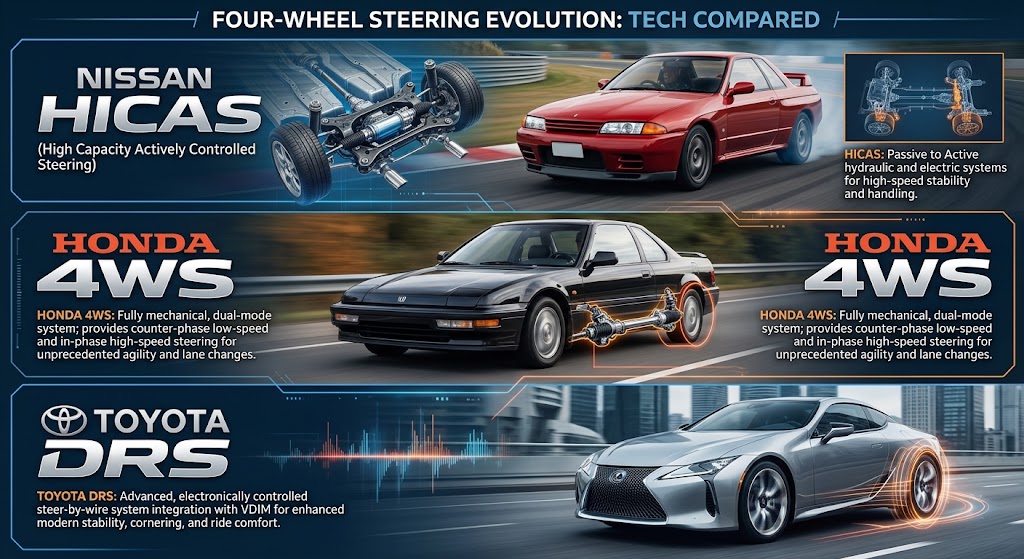
Nissan HICAS & Super HICAS: High-Speed Yaw Stabilization
Debuting on the R31 Skyline in 1985 and refined through the R32, R33, R34, and S13/S14/S15 platforms, HICAS (High Capacity Actively Controlled Steering) was engineered strictly for high-speed dynamic control rather than tight parking assistance.
- HICAS (Hydraulic): Used on earlier chassis (R32 GT-R, early S13 180SX/Silvia). It tapped power steering hydraulic fluid pressure, routed via an auxiliary pump and rear-mounted hydraulic solenoid valves, to actuate tie-rods connected to the rear hubs.
- Super HICAS (Electric): Debuted around 1993 (late R32, R33, R34, S14, S15). It replaced the complex, leak-prone hydraulic lines with an electronically controlled high-torque DC actuator motor mounted directly across the rear subframe.
- Dynamic Logic: Unlike low-speed systems, HICAS operates only above specific speeds (typically 50–80 km/h). Under initial steering wheel turn-in, the system briefly steers the rear wheels counter-phase (opposite to the front wheels) by up to 1 degree to initiate sharp vehicle yaw rotation, then instantly reverses to steer in-phase (same direction as front wheels) by up to 1 degree to stabilize lateral grip and prevent snap-oversteer.
Honda 4WS: Mechanical Geared Linkage to Electronic Dynamic Control
In 1987, Honda stunned the automotive world by introducing the third-generation Prelude (BA4/BA5) equipped with the world’s first mass-produced steer-angle-dependent four-wheel steering system.
- Mechanical 4WS (Prelude BA4): Honda avoided computers and hydraulics entirely in its original design. A mechanical center steering shaft ran from the front steering rack beneath the chassis to a dedicated rear gearbox containing a planetary gear assembly.
- Steer-Angle Dependent Geometry: Small steering inputs (under ~140 degrees of steering wheel rotation, typical for high-speed lane changes) steered the rear wheels in-phase by up to 1.5 degrees. Turning the steering wheel past 240 degrees (sharp corners, U-turns, parallel parking) mechanically reversed the internal planetary gear, turning the rear wheels counter-phase by up to 5.3 degrees. This dropped the car’s turning circle dramatically.
- Electronic 4WS / 4WS-EL: Fourth- and fifth-generation Preludes and the Accord 4WS transitioned to an electronically managed stepper-motor actuator that evaluated vehicle road speed alongside steering angle.
Toyota 4WAS & Dynamic Rear Steering (DRS)
Toyota integrated rear steering across luxury grand tourers and premium sedans (Soarer, Aristo, Crown, and later Lexus GS/IS/LS platforms with Lexus Dynamic Handling):
- Modern DRS Integration: Modern Toyota/Lexus architectures fuse Variable Gear Ratio Steering (VGRS) on the front axle with an electric rear actuator motor (DRS).
- Adaptive Logic: At low city speeds (under 60–80 km/h), the rear wheels turn counter-phase (up to 2.5–3.5 degrees), virtually shortening the wheelbase to make large 5-meter executive sedans turn like compact hatchbacks. At highway speeds, the rear wheels turn in-phase, providing smooth, crab-walk lane changes with zero chassis sway.
2. Engineering & Technical Comparison Matrix
| Attribute | Nissan Super HICAS | Honda Mechanical 4WS | Toyota / Lexus DRS |
|---|---|---|---|
| Primary Actuation | High-torque DC Electric Actuator on Rear Subframe | Mechanical Center Shaft + Planetary Rear Gearbox | Integrated Electric Brushless Actuator + Tie-rods |
| Operational Purpose | High-Speed Stability & Track Yaw Damping | Dual: Low-Speed Turning Circle + High-Speed Stability | Low-Speed Maneuverability & High-Speed Highway Composure |
| Maximum Rear Steer Angle | ~1.0° (Subtle yaw control) | Up to 5.3° (Counter-phase) / 1.5° (In-phase) | Up to 2.5° – 3.5° |
| Low-Speed Parking Help | No (Inactive at parking speeds) | Exceptional (Drastically cuts turning radius) | Exceptional (Shrinks vehicle turning radius) |
| Common Maintenance Failures | Subframe ball joint wear, actuator sensor desync | Rear gearbox play, center shaft universal joint wear | Rear actuator motor position sensor fault, 12V battery drops |
| Popular Export Auction Models | Skyline GT-R (R32/R33/R34), Silvia (S14/S15), Fairlady Z (Z32) | Prelude (BA4/BA5/BB1/BB4), Accord 4WS | Crown Athlete/Majesta (AWS210/GWS214), Lexus GS350 F Sport |
3. Auction Inspection & Troubleshooting Guide for Importers
1. The “HICAS” Light on Nissan Performance Stock
When bidding on classic R32/R33/R34 Skylines or Silvia S14/S15 specs, check the instrument cluster. If the amber “HICAS” warning light remains illuminated while driving, the system has entered fail-safe mode. Common causes include:
- Worn outer tie-rod ball joints pressed directly into the rear aluminum knuckle.
- Steering angle sensor misalignment (frequently caused by installing an aftermarket steering wheel without an adapter boss kit that supports the optical angle reader).
- Blown power steering hydraulic solenoid seals on early R32/Z32 models.
Note: Many Japanese owners install aftermarket “HICAS Eliminator / Lockout Bars.” If the auction sheet notes a HICAS cancel bar, verify that the rear alignment has been locked correctly to avoid rear tire scrubbing during transit.
2. Four-Wheel Alignment Calibration on Honda 4WS
Inspecting classic Preludes requires strict alignment checks. Because the rear wheels turn mechanically, an inexperienced alignment shop performing a front-end toe adjustment can inadvertently throw the rear mechanical center out of alignment. Honda equipped these vehicles with a locking maintenance pin hole under the rear subframe gearbox to center the rear rack before setting alignment angles.
3. Low-Speed Reverse Binding on Modern Toyota/Lexus DRS
On late-model Toyota Crown, Mark X, and Lexus GS/LS auction stock with Dynamic Rear Steering, test low-speed full-lock reversing. If you feel hesitation, abnormal motor vibration, or an amber chassis warning lamp, scan the chassis CAN bus for steering angle sensor drift or rear actuator motor torque faults.
Frequently Asked Questions (FAQ)
1. Why do many drifters and track drivers remove Nissan Super HICAS?
HICAS was designed to make vehicles grip and resist sliding by counteracting oversteer at high speeds. In competitive drifting, the driver intentionally initiates and sustains rear-wheel slip. HICAS’s counter-phase turn-in followed by sudden in-phase stabilization makes slide transitions unpredictable for drift drivers, prompting many to install lockout kits.
2. Does Honda’s mechanical 4WS system require special power steering fluid?
The original third-generation Prelude mechanical 4WS system operates entirely with dry gears, shafts, and planetary mechanisms; it does not connect to the front hydraulic steering loop. The rear gearbox uses standard automotive multi-purpose chassis grease rather than hydraulic fluid.
3. How does four-wheel steering affect tire wear?
When functioning correctly, systems like Honda 4WS and Toyota DRS actually reduce tire shoulder scrubbing in tight parking lots by pivoting the vehicle cleanly. However, if rear ball joints develop play or alignment calibrations drift, the rear wheels can run excess dynamic toe-in or toe-out, causing rapid, uneven inner tread wear.
4. Can Qualitex Trading inspect HICAS and 4WS systems prior to export?
Yes. Our certified vehicle inspectors check steering warning indicators, test for play in rear tie-rod ball joints, and verify whether aftermarket lockout bars have been installed on all auction stock prior to bidding.
Looking for Verified JDM Sports & Luxury Vehicles Direct from Japan?
At Qualitex Trading Co. Ltd, our team inspects auction sheets and chassis conditions across USS, TAA, CAA, and ARAI auction houses daily. Whether you are importing an iconic Skyline GT-R or a luxury Toyota Crown, contact our export specialists today for professional auction translation, mechanical inspection, and worldwide shipping.
Ready to Import Your Next Vehicle?
Qualitex Trading Japan provides direct access to over 100,000+ Japanese used cars at auction prices. We handle bidding, inspection, and global shipping.