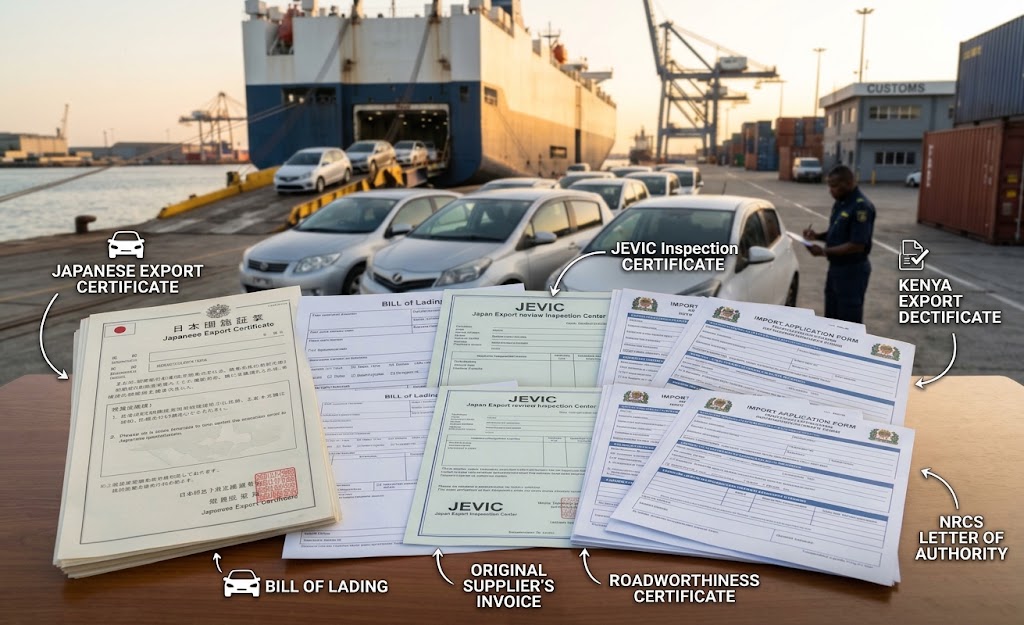
Short answer: almost every country asks for the same core papers: the supplier’s invoice, the bill of lading, and the document that shows the car has been taken off the Japanese register, which importers call the export certificate. After that the lists diverge. Some countries add an inspection certificate from an approved firm, some ask for a tax number, and Kenya has added an export declaration rule this year. We checked the lists below against Japan Customs and each country’s authority on 16 November 2026. Ask your clearing agent for the current list for your country, because these lists change.
Key points (checked 16 November 2026)
- In Japan: Japan Customs says the owner must first obtain a Certificate of Registration Deletion. If the registration is already deleted, the owner returns it and obtains a Certificate of Notice of Planned Export. Both are valid for six months and are issued at a Transportation Office or a Motor Vehicle Inspection and Registration Office.
- Core papers: invoice, bill of lading, and the deregistration or export certificate. The original, not a copy, is what the authorities in the UK, New Zealand, and Kenya ask for.
- Inspection certificates: Inspection certificates: Kenya (KEBS-appointed inspector), Uganda (UNBS pre-export verification), Pakistan (accepted pre-shipment inspection firms), New Zealand (an approved border inspection), and Jamaica and Guyana (Auto Terminal Japan for cars from Japan) each have their own.
- New in 2026: Kenya’s Section 23B requires importers to hold an export declaration or equivalent from the exporting country and keep it for five years.
What Japan requires before the car leaves
Japan Customs’ answer on exporting used vehicles says the owner of a registered vehicle must apply for the registration to be deleted and obtain the Certificate of Registration Deletion in advance. If the registration has already been deleted, the owner returns that certificate and obtains a Certificate of Notice of Planned Export. The owner then provides the relevant certificate to customs at the export inspection. Both certificates are valid for six months from the date of issue, and the application is made at a Transportation Office or a Motor Vehicle Inspection and Registration Office.
The Japan Customs page is undated, and it cites the law’s effective date as 1 January 2005. For other questions it directs readers to a customs counselor. Ask your exporter which certificate it will supply and when.
What each country asks for
| Market | Documents we found | Source |
|---|---|---|
| United Kingdom | For the HMRC notification: the C88 and E2 customs documents or the MRN, an invoice or bill of sale, a document that confirms the VIN or chassis number, such as an export certificate, and a UK valuation if you bought the car more than six months ago. For the DVLA: the original foreign registration certificate (not returned), evidence of the collection date such as the supplier’s invoice, proof of approval if the car is under 10 years old, and MOT evidence if over three years old | GOV.UK |
| New Zealand | The original export certificate issued by Japan’s Ministry of Land, Infrastructure, Transport and Tourism with a type designation number and a model code, or a completion inspection certificate. For a Kei car, the export certificate is issued by the Light Motor Vehicle Inspection Organisation. Proof of ownership back to the last registered owner in Japan | NZTA |
| Kenya | The original commercial invoice, the original logbook cancelled in the country of origin, the original bill of lading, the pre-shipment inspection certificate, and your KRA PIN. Plus an export declaration, export entry, customs export certificate, or equivalent from the country of export, for goods imported from 1 September 2026. | KRA, Deloitte |
| Australia | Import approval before shipping, with proof of the build date for a car 25 years or older, such as the original sales document, a deregistration certificate, or a photo of the chassis plate. | Australian Government |
| Jamaica | An import license from the Trade Board, applied for before you ship; for a used car, a pre-shipment inspection certificate from Auto Terminal Japan; the title or export certificate; the bill of lading; the invoice; a Tax Compliance Certificate; and a Special Declaration prepared by a licensed customs broker. | Jamaica Customs Agency, Trade Board | Jamaica Customs Agency |
| Guyana | The bill of lading, the invoice, and the applicant’s TIN, with a cancellation of registration if needed. For a used vehicle shipped on or after 1 February 2025, a vehicle inspection certificate from AutoTerminal Japan, uploaded with the other documents in ASYCUDA. Without it, the customs declaration may not be processed. | Guyana Revenue Authority | Guyana Revenue Authority |
| Uganda | A roadworthiness certificate from pre-export verification; without one, a 15% penalty on CIF value and a $140 destination inspection | UNBS, as reported |
| Pakistan | A pre-shipment inspection certificate issued through an accepted firm for gift and TR cars. Customs verify it with the local firm. | Ministry of Commerce, as reported |
| South Africa | A permit from the International Trade Administration Commission, an NRCS letter of authority, and customs clearance papers, which SARS says are the legal requirements. ITAC does not issue permits for second-hand vehicles for use on the road, according to SARS in 2020 | SARS |
Each country’s own guide gives the detail. Read our guides to Kenya and Australia, and our explainer on SRO 61(I)/2026 in Pakistan.
Why the originals matter
Three authorities say so directly. The DVLA asks for the original foreign registration certificate and says it does not return it and that photocopies are not accepted. NZTA asks for the original export certificate or a completion inspection certificate for a car never registered in Japan. KRA asks for the original invoice, logbook, and bill of lading. If you buy through an auction or a dealer, ask for the originals to be sent to you, and check that the chassis number on every document matches the car.
Questions to ask your exporter
- Which certificate will you supply: the Certificate of Registration Deletion or the Certificate of Notice of Planned Export?
- Will I get the original, and how and when will it reach me?
- Does the document show the chassis number, model code and manufacture date, and do they match the car?
- Will you supply an inspection certificate from the firm my country accepts, and who issues it?
- Will the bill of lading be issued in my name or my consignee’s name?
- Is every document in a language my authority accepts, or does it need a certified translation? NZTA says certified English translations of documents not in English may be required in some cases.
- How long will the Japanese certificate stay valid compared with my shipping date? It is valid for six months from issue.
Frequently asked questions
What is the export certificate for a used car from Japan?
It is the document that shows a car has left the Japanese register. Japan Customs names two: the Certificate of Registration Deletion for a registered vehicle and the Certificate of Notice of Planned Export, where the registration has already been deleted.
How long is the Japanese certificate valid?
Japan Customs says six months from the date of issue.
Do I need the original or a copy?
The UK, New Zealand, and Kenya all ask for originals. The DVLA does not accept photocopies.
Which document do I need for Kenya’s new export declaration rule?
KRA has not said which Japanese document counts for a used car. The law accepts an export declaration, export entry, customs export certificate, or equivalent document and lets the Commissioner waive the rule where the exporting country does not issue export declarations. Clearing agents have argued that the vehicle export certificate should be enough, but KRA has defended the rule. Ask your exporter for a copy of the Japanese customs export declaration as well, and check with your clearing agent.
Do all countries need an inspection certificate?
No. Kenya, Uganda, Pakistan, New Zealand, Jamaica, and Guyana have inspection requirements, each with its own approved firms. The UK asks for vehicle approval instead for cars under 10 years old.
Last checked: 16 November 2026
We wrote this guide from the official pages and reports linked in each market’s guide, and from the Japan Customs page below on 16 November 2026. Lists of documents change by notice, so check yours before you ship.
Sources
- Japan Customs, Customs procedures for exporting used vehicles
- GOV.UK, Telling HMRC and Registering an imported vehicle
- NZ Transport Agency, Used vehicles from Japan
- Kenya Revenue Authority and Deloitte, as set out in our Kenya guide
- Department of Infrastructure, Transport, Regional Development, Communications and the Arts, as set out in our Australia guide
- Jamaica Customs Agency, Documents required to import a motor vehicle
- Guyana Revenue Authority, Motor vehicle imports
- Pulse Uganda, UNBS slaps tight restrictions on imported used cars, reporting the UNBS statement of 28 September 2023
- Profit (Pakistan Today), report on the Japan inspection certificates, 24 June 2026
- South African Revenue Service, Importation of a second-hand vehicle, 4 September 2020
- Guyana Revenue Authority, Inspection Certificate Requirement, 27 January 2025
- Jamaica Customs Agency, Documents Required To Import a Motor Vehicle or Motor Cycle, undated
- Ministry of Foreign Affairs and Foreign Trade (Jamaica), The Trade Board Limited: services and import permit requirements, undated
- Kenya Revenue Authority, Finance Act 2026: What It Means for You, 2026
Ready to Import Your Next Vehicle?
Qualitex Trading Japan provides direct access to over 100,000+ Japanese used cars at auction prices. We handle bidding, inspection, and global shipping.