By Qualitex Trading Technical Editorial Team | Japan Used Vehicle Export Insights
For international car dealerships, fleet managers, and individual buyers importing used Japanese Domestic Market (JDM) vehicles, hybrid powertrains represent the highest-volume segment at auto auctions across Tokyo, Yokohama, and Nagoya. However, not all hybrids behave the same way under the hood.
Japan’s top three automakers—Toyota, Honda, and Nissan—each took radically distinct engineering paths to solve efficiency, battery management, and drive delivery. Choosing the right platform depends entirely on your market’s road infrastructure, ambient climate, high-speed highway availability, and local mechanic expertise. Here is a technical breakdown of how Toyota THS, Honda e:HEV, and Nissan e-POWER work, how they hold up over time, and which vehicles best fit your destination port.
1. Technical Drivetrain Architectures
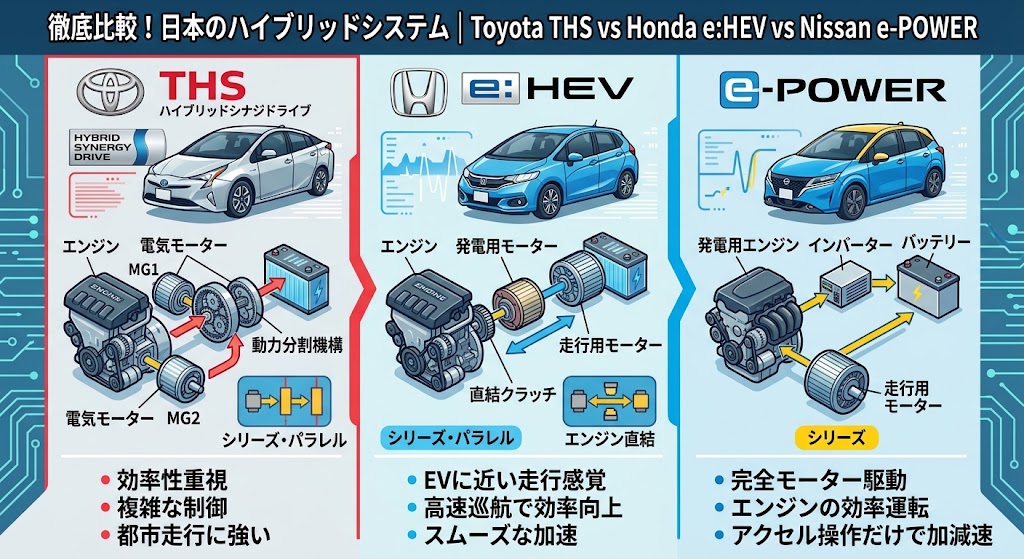
Toyota Hybrid Synergy Drive (THS II): The Planetary Power-Split
Toyota’s system, perfected across millions of Prius, Aqua, and Corolla units, is a series-parallel power-split hybrid. At its center sits a mechanical planetary (epicyclic) gear device that interconnects three power inputs and outputs:
- The Internal Combustion Engine (ICE), running an ultra-efficient Atkinson cycle.
- MG1 (Motor-Generator 1): Manages engine start, variable gear ratios, and generation of electrical buffer current.
- MG2 (Motor-Generator 2): Drives the wheels directly and harvests kinetic energy via regenerative braking.
Because there are no hydraulic clutch packs, friction bands, belts, or stepped gear sets, the transmission acts as an electronic continuously variable transmission (e-CVT). Mechanical wear within the transaxle casing is near non-existent under regular fluid change intervals.
Honda e:HEV: Two-Motor Intelligent Multi-Mode Drive
Honda discarded planetary power-split gears in favor of a dual-motor series-parallel setup designed around real-world driving conditions:
- Urban Driving (Series Hybrid Mode): The gasoline engine spins an onboard electric generator. That electrical energy feeds a powerful primary traction motor that turns the front wheels. The engine is completely decoupled from the drive axle at low to medium city speeds.
- Highway Cruising (Parallel Direct-Drive Mode): At sustained cruising speeds (typically between 70 km/h and 110 km/h), a hydraulic wet lock-up clutch engages. The engine connects directly to the drive axle through a single-ratio tall overdrive gear.
This layout circumvents the “double energy conversion penalty” (converting kinetic engine power to electricity, then back to kinetic rotational force via a traction motor) where traditional series hybrids lose efficiency at highway speeds.
Nissan e-POWER: The Pure 100% Electric Serial Drivetrain
Nissan took the most unconventional route by building an electric vehicle that carries its own onboard generator:
- The ICE (such as the 1.2L HR12DE or the 1.5L VC-Turbo KR15DDT) has zero mechanical connection to the drive wheels.
- The engine operates strictly as a generator unit, channeling power through an inverter to a compact lithium-ion battery buffer pack (1.5 kWh–2.1 kWh) and a high-torque electric traction motor derived directly from the all-electric Nissan Leaf.
Because the traction motor exclusively turns the wheels, the vehicle delivers immediate peak torque from a standstill, seamless one-pedal driving, and linear throttle response without traditional gear shifts or shift lag.
2. Engineering & Export Comparison Matrix
| Specification / Attribute | Toyota THS II | Honda e:HEV | Nissan e-POWER |
|---|---|---|---|
| Drivetrain Classification | Series-Parallel (Power-Split) | Dual-Motor Series/Parallel (Direct Clutch) | Pure Serial Hybrid (Electric Drive) |
| Friction Wear Parts in Transaxle | None (Planetary gears only) | 1 Wet Hydraulic Multi-Plate Clutch | None (Direct Reduction Gear) |
| EV-Style Driving Dynamics | Moderate (Linear with engine drone under kickdown) | Strong (Smooth electric city feel; quiet highway) | 100% EV Instant Torque (High off-the-line pull) |
| Fuel Economy: Dense City Stop-and-Go | Excellent | Excellent | Class-Leading (High regeneration efficiency) |
| Fuel Economy: Sustained Highway Speeds | High | Class-Leading (Direct mechanical lock-up) | Moderate (ICE runs at higher RPM to feed inverter) |
| Key High-Volume Export Models | Prius (ZVW30/50), Aqua (NHP10), Fielder Hybrid | Fit (GR3), Vezel (RV3), Stepwgn e:HEV | Note (E12/E13), Serena (C27/C28), Kicks (P15) |
3. Export Practicalities: Reliability, Diagnostics, and Parts
Toyota THS II: The Uncontested Export Benchmark
For developing markets throughout East Africa, the Caribbean, and South America, Toyota’s THS II is unmatched in aftermarket serviceability. The widespread use of prismatic NiMH and compact Li-ion cells means replacement battery packs, reconditioned modules, and inverter parts can be sourced in virtually any major port city. If your local technicians are familiar with general hybrid diagnostics via standard OBD-II protocols, THS presents the lowest after-sales operational risk.
Honda e:HEV: The Driver-Centric Highway Commuter
Honda’s dual-motor setup is ideal for markets featuring well-maintained highway networks and buyers who dislike the high-RPM “drone” characteristic of traditional planetary CVTs. Maintenance is straightforward, but it requires strict adherence to Honda Ultra ATF-TYPE 3.1 or e:HEV-specific fluid changes to protect the multi-plate clutch assembly over 100,000+ kilometers.
Nissan e-POWER: The Hill Climber & City Champion
Because propulsion is purely driven by an electric traction motor, e-POWER vehicles excel in dense metropolitan traffic and hilly terrain. The instant low-end torque pulls loaded minivans like the Serena e-POWER up steep inclines without gear hunting. However, sustained 120+ km/h cruising forces the generator to work harder, causing higher fuel consumption compared to Honda or Toyota on long open highways. Sourcing battery diagnostics for high C-rate Nissan packs requires up-to-date scan tools in the receiving country.
Frequently Asked Questions (FAQ)
1. Does the Nissan e-POWER need to be plugged in to charge?
No. e-POWER vehicles are 100% self-charging. You fill them with regular petrol at any standard fuel pump. The internal combustion engine automatically starts and stops to maintain the high-output traction battery buffer.
2. Which hybrid platform is easiest to maintain in emerging markets?
Toyota THS II remains the easiest platform to support. Because models like the Toyota Prius (ZVW30) and Aqua (NHP10) have been exported in volume for over a decade, spare parts, battery balancing equipment, and salvage yard spares are readily available across international markets.
3. Why does the engine rev loudly when accelerating in a Toyota hybrid?
This is standard behavior dictated by the planetary power-split device. When sudden torque is requested, the Electronic Control Unit (ECU) immediately brings the gasoline engine to its peak thermal efficiency RPM band. The car accelerates as the electric motor and planetary split catch up, decoupling engine RPM pitch from vehicle road speed.
4. How do hot climates affect JDM hybrid battery packs during export?
Excessive cabin heat degrades hybrid battery life. Most Japanese hybrids route cooling air to the battery pack from vents located near the rear seats. Keeping these air intake vents clear of dust and lint, cleaning the internal cooling fan blades, and inspecting filter elements ensures healthy battery life even in tropical export destinations.
Looking for Verified Hybrid Stock from Japanese Auto Auctions?
At Qualitex Trading Co. Ltd, our team inspects auction sheets and vehicle conditions across USS, TAA, CAA, and ARAI auction houses daily. Whether you need container consolidation, RoRo shipping, or pre-export mechanical inspections for Africa, the Caribbean, or Europe, contact our export specialists today to source top-tier hybrid inventory.
Ready to Import Your Next Vehicle?
Qualitex Trading Japan provides direct access to over 100,000+ Japanese used cars at auction prices. We handle bidding, inspection, and global shipping.