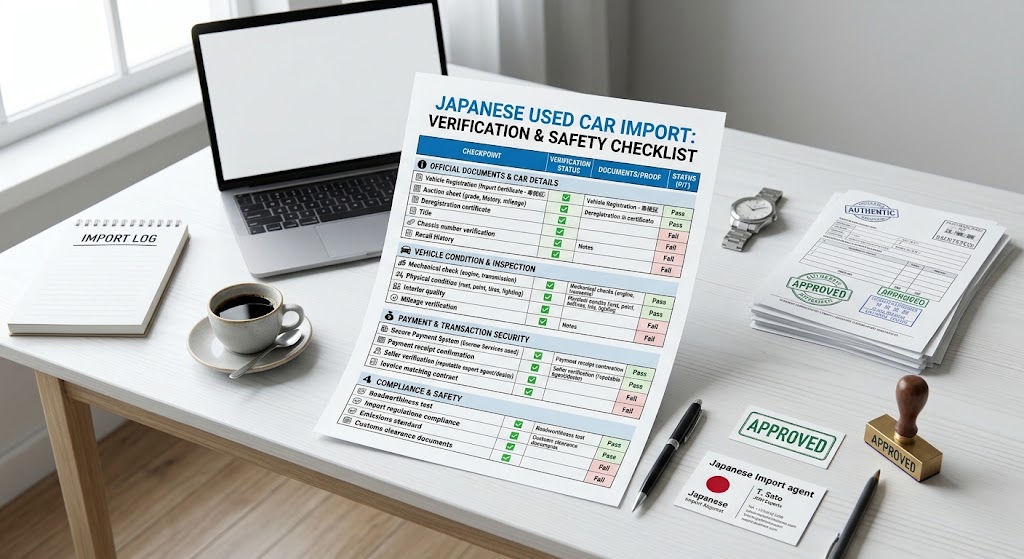
Short answer: check the exporter against sources that are independent of the exporter before you send any money, and pay through a route that holds your money until the car ships. Japanese embassies in Tanzania and Rwanda have published warnings about used-car fraud, and the embassy in Barbados has warned buyers after receiving a large number of inquiries. The Rwanda and Barbados notices add that the embassy cannot settle a commercial dispute. We read those notices, the Japan Used Motor Vehicle Exporters Association (JUMVEA) page on its payment service, and Japan’s Secondhand Goods Business Act on 13 November 2026, and built the checklist below from them.
Key points (checked 13 November 2026)
- The risk is real and official. The Embassy of Japan in Rwanda reported “several reports of problems” with importing used cars, and said online advertisements may be fraudulent. The Embassy in Barbados reported on 27 May 2026 that it had received a large number of inquiries.
- Embassies cannot help you recover money. The Rwanda notice says the embassy is not in a position to assist, investigate or intervene in commercial disputes, and the Barbados notice says it cannot provide assistance or a guarantee on commercial matters.
- JUMVEA is described by the Rwanda notice as a non-profit business association approved by Japan’s Ministry of Economy, Trade and Industry (METI). Its member list and its Safe Trade payment service are the checks the embassies name.
- A membership list is not a guarantee. The Rwanda embassy says it cannot guarantee the authenticity of each member.
- Japan’s law requires a dealer permit for secondhand goods dealing, and an online dealer must publish its permit number. Ask for it.
What the official notices say
| Source | Date | What it says |
|---|---|---|
| Embassy of Japan in Tanzania, with JETRO Nairobi | 9 March 2022 | JETRO urges importers to contact it before dealing with a Japanese seller. Some importers are lured by low prices and send money without confirming the seller is reliable, and money sent to fraudsters cannot be recovered. JETRO has a list of genuine registered companies that export used vehicles |
| Embassy of Japan in Rwanda | 5 January 2023 | Online adverts for used cars may be fraudulent. Buyers can have limited ability to take legal action because of insufficient evidence. A buyer who suspects fraud should report it to the local police, and Japan’s police investigate on requests received through Interpol, though the outcome is not guaranteed |
| Embassy of Japan in Barbados | 27 May 2026 | The embassy cannot provide any assistance or guarantee on commercial matters. It advises buyers to check Japanese dealers on the JUMVEA website, and points to the Japan Federation of Bar Associations if legal help is needed |
The checklist
1. Contact JETRO first
JETRO’s Nairobi office, which covers East African Community countries, asks buyers to contact it before they commit to a Japanese seller. It says it keeps a list of genuine registered companies in Japan that export used vehicles. If you are outside East Africa, ask the Japanese embassy in your country which JETRO office covers you.
2. Check the JUMVEA members list
JUMVEA publishes a list of its members. The embassies point to it, and the Rwanda embassy says buyers may find it useful but that it cannot guarantee that each member is genuine. The member counts in the notices differ: about 400 in the 2022 and 2023 notices and more than 230 in the 2026 notice, so we cannot give a current count. Check the list yourself on the JUMVEA website, and check that the company contacting you appears there with the same name, address and contact details.
3. Pay through a protected route
JUMVEA runs a payment service called JUMVEA Safe Trade (JUST). According to JUMVEA:
- You choose a car from a JUST member’s stock and ask the member for a proforma invoice to pay through JUST.
- The proforma invoice shows the car’s FOB price plus a handling charge of JPY 20,000 or US$200 for each payment.
- You send the money to JUMVEA’s bank account only, as shown on the invoice.
- JUMVEA keeps the money until the supplier ships, and checks the bill of lading to confirm the car is on board.
- JUMVEA releases the money to the supplier after it receives the bill of lading, and the supplier sends the documents.
- JUMVEA says it pays back the money, less bank transfer charges, if you do not receive the car or the documents.
Ask the seller whether it is a JUST member and whether it will sell through JUST. Treat a seller that refuses any protected route and wants money sent to a personal or unfamiliar account as a warning sign. The JETRO message in the Tanzania and Rwanda embassy notices calls JUMVEA Safe Trade the safest way to import a used car and says JUMVEA guarantees delivery. Even so, read JUMVEA’s current terms before you rely on it.
4. Ask for the dealer’s permit number and check it
Japan’s Secondhand Goods Business Act (Act No. 108 of 1949) says that anyone who runs a secondhand goods dealing business must receive a permit from a Prefectural Public Safety Commission (Article 3). A dealer that sells online must publish its name, the name of the Public Safety Commission that granted the permit, and its permit number (Article 12(2)). Dealing without a permit carries up to three years’ imprisonment or a fine of up to one million yen (Article 31). Ask the exporter for its permit number, and check it with the issuing commission. The Act covers any business that buys and sells used goods, which, in its wording, includes an exporter that buys used cars in Japan to resell them. A dealer that sells through a website should show its permit number there. Ask the exporter for its permit number, and check it with the issuing commission. We found no official statement aimed at exporters specifically, so treat the permit as one check, not the only one.
5. Be wary of a price that is too low
JETRO’s notice says some importers are lured by low prices and send money without checking the seller. Compare the price with the same model from at least two other suppliers.
6. Keep a record
The Rwanda embassy notes that insufficient evidence can limit legal action. Keep the adverts, messages, invoices and payment receipts, and save a copy of the exporter’s registration and permit details before you pay.
If you have already paid and the car does not arrive
The Rwanda embassy advises reporting suspected fraud to your local police. It says Japan’s police act on reports and requests that come through Interpol, but that the outcome is not guaranteed. The Barbados embassy points buyers who want legal help to the Japan Federation of Bar Associations’ list of English-language bar association pages. Neither embassy will intervene in the dispute.
Before you pay: a checklist
- JETRO: have you contacted the JETRO office that covers your country?
- JUMVEA: is the exporter on the members list, with matching details?
- Payment: will the exporter use JUMVEA Safe Trade or another protected route?
- Permit: have you asked for and checked the dealer permit number?
- Price: have you compared it with other suppliers for the same model?
- Documents: will you receive the bill of lading and the export certificate?
- Records: have you saved everything the exporter sent you?
How to check us
You can run the checks above on Qualitex Trading Co., Ltd. as well.
- Company registration: we are a company registered in Japan, based in Ebina, Kanagawa.
- JUMVEA: we are a JUMVEA member. Our entry on the JUMVEA members list shows membership ID 000765 and membership since 1996. As this guide says, a listing is not a guarantee, so check the name, address and contact details on it against the details we give you.
- Chambers of commerce: we are a member of the Ebina and Tokyo chambers of commerce.
- Payment: our bank account details are published on our Bank Details page. We ask clients to send payment only to those accounts and not anywhere else, and our scam alert lists names and contact details that are not ours. If anyone asks you to pay into a different account in our name, check with us before you send money.
- Contract: we sign a contract with a client before we start doing business, and the contract states the payment terms clearly.
- Letter of credit: we offer a letter of credit (L/C) facility, as our terms and conditions state.
More on buying safely
Read our guide to reading a Japanese auction sheet before you bid.
Frequently asked questions
How do I know a Japanese used car exporter is genuine?
Check the exporter against sources outside its own website: JETRO, the JUMVEA members list, and its dealer permit number. Pay through a protected route.
What is JUMVEA?
The Japan Used Motor Vehicle Exporters Association. The Rwanda notice describes it as a non-profit, government-recognised association approved by METI that publishes a members list and runs a payment service called JUMVEA Safe Trade.
Can the Japanese embassy get my money back?
Not according to the notices we read. The Rwanda notice says the embassy cannot assist, investigate or intervene in commercial disputes, and the Barbados notice says it cannot provide assistance or a guarantee on commercial matters.
How does JUMVEA Safe Trade work?
You pay into JUMVEA’s bank account, JUMVEA holds the money until the supplier ships and sends the bill of lading, then releases it. JUMVEA charges JPY 20,000 or US$200 for each payment.
Is a JUMVEA membership a guarantee?
No. The Rwanda embassy says it cannot guarantee that each listed member is genuine, so check the details yourself.
Is Qualitex a JUMVEA member?
Yes. Qualitex Trading Co., Ltd. is a JUMVEA member, listed on JUMVEA’s website with membership ID 000765 and membership since 1996. We are also a member of the Ebina and Tokyo chambers of commerce.
How does Qualitex handle payment?
Pay only into the bank accounts listed on our Bank Details page, and nowhere else. We sign a contract with a client before we start doing business, and the contract states the payment terms clearly. We also offer a letter of credit (L/C) facility, as our terms and conditions state.
Do Japanese used car dealers need a licence?
Japan’s Secondhand Goods Business Act requires a permit from a Prefectural Public Safety Commission for any business that buys and sells used goods, and a dealer selling online must show its permit number on its website. Ask for the permit number and check it.
Last checked 13 November 2026
We wrote this guide from the notices, the JUMVEA page and the statute listed below on 13 November 2026. JUMVEA’s fees and rules can change, so read its current page before you pay. The section about us rests on our own statements, our Bank Details, scam alert and terms and conditions pages and our JUMVEA member profile, which we read on 2 November 2026.
Sources
- Embassy of Japan in Tanzania, Notice to all importers of used motor vehicles from Japan, 9 March 2022
- Embassy of Japan in Rwanda, Important notice on online purchase and importing of used cars, 5 January 2023
- Embassy of Japan in Barbados, Important notice on the purchase of used cars and car parts from Japan, 27 May 2026
- Japan Used Motor Vehicle Exporters Association, JUMVEA Safe Trade
- Japan Used Motor Vehicle Exporters Association, QUALITEX TRADING Co. Ltd. member profile
- Japanese Law Translation, Secondhand Goods Business Act (Act No. 108 of 1949)
Ready to Import Your Next Vehicle?
Qualitex Trading Japan provides direct access to over 100,000+ Japanese used cars at auction prices. We handle bidding, inspection, and global shipping.