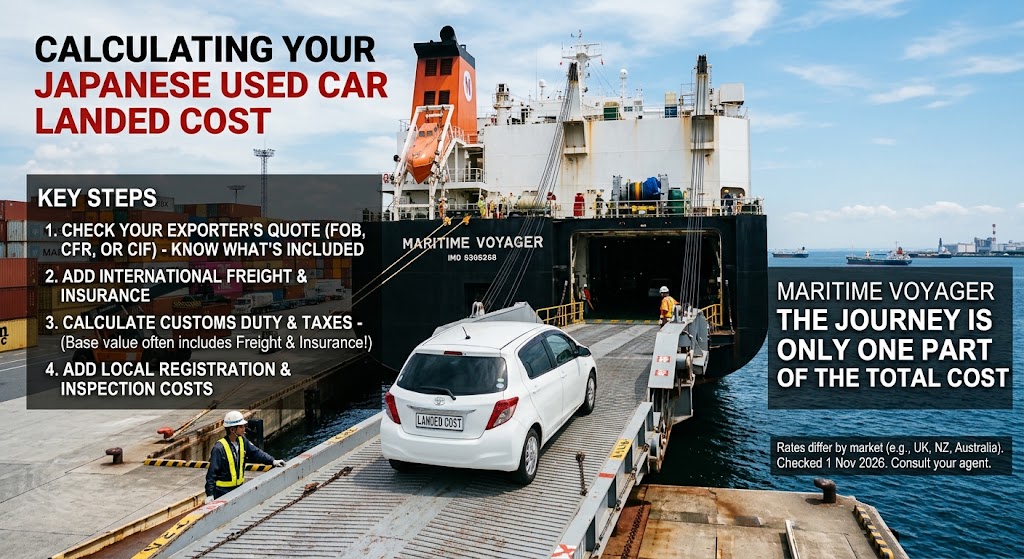
Short answer: the landed cost of a used car is the price you pay the exporter, plus any freight and insurance that the price does not include, plus customs duty and taxes, plus port, clearance, inspection, and registration costs in your own country. In most markets the tax at the border is charged on a value that includes freight and insurance, and in many the duty is too, so a higher freight bill also raises your bill at the border. The rates differ from market to market, so this guide shows the method and then what we found for each market on 16 November 2026.
Key points
- Start with the trade term. FOB, CFR, and CIF tell you how much of the journey the exporter’s price covers.
- Ask what duty and tax are charged on. In the markets below, the tax base includes freight and insurance or is a reference price, not the invoice alone. Some countries, such as Australia, charge duty on a value close to the FOB price and add freight only for GST.
- Do not compare quotes on different terms. An FOB price and a CIF price for the same car are not the same offer.
- Rates change. Every figure below carries the date we checked it. Ask your clearing agent for a written assessment of the exact car.
Step 1: what your exporter’s price covers
Trade terms are short codes from the International Chamber of Commerce’s Incoterms rules. Three of them matter for a car shipped by sea:
| Term | Meaning | What it means for your costs |
|---|---|---|
| FOB | Free on Board, with a named port of loading | The price covers the car to the Japanese port. You pay the sea freight and insurance, and everything after |
| CFR | Cost and Freight, with a named port of destination | The price includes sea freight to your port. You pay the insurance and everything after the port |
| CIF | Cost, Insurance and Freight, with a named port of destination | The price includes freight and insurance to your port. You pay duty, tax and local costs |
The US International Trade Administration lists FOB, CFR and CIF among the four Incoterms rules for sea and inland waterway transport only. The ICC says CIF is reserved for maritime trade and that its insurance cover defaults to Institute Cargo Clauses (C) unless the parties agree higher cover. Always name the port, because the term only has a meaning with it, and ask the exporter to say in writing what the price excludes.
Step 2: the duty and tax base
This is the step buyers most often get wrong. The base is not always the invoice price. In the markets we have checked:
| Market | What duty and tax are charged on | Source and date |
|---|---|---|
| United Kingdom | VAT (20%) on the car’s total cost plus accessories, delivery and extra charges, plus the customs duty. Duty is 10%, or 0% for a car that originates in Japan and can prove it | GOV.UK and the UK Trade Tariff, 16 Nov 2026 |
| New Zealand | GST (15%) on what you paid plus international freight, insurance, and any duty. Customs lists car duty at 0% | NZ Customs, 16 Nov 2026 |
| Australia | GST of 10% of the value of the taxable importation (customs value plus duty, freight, and insurance). Customs duty is free for a used car that originates in Japan and can prove it under the Japan–Australia trade agreement; otherwise, 5% on most used passenger car lines. A luxury car tax of 33% applies above a threshold. | Australian Border Force, ATO and Parliament of Australia, 16 Nov 2026 | Australian Border Force and ATO, 16 Nov 2026 |
| Kenya | Customs value is the Customs Retail Selling Price (CRSP) less depreciation, not the invoice. | KRA, June 2025, with the valuation list before the High Court |
| Uganda | The Daily Monitor reports duty, VAT, withholding tax, excise, and levies on the CIF value, adding 40% to 60% to the price. | Daily Monitor, 31 Dec 2025 |
| Pakistan | A 30% regulatory duty on commercial imports of used cars (down from 40%), charged on top of other duties. We found no verifiable table for gift and TR cars. | SRO 1065(I)/2026, 30 Jun 2026 | SRO 1065(I)/2026, 30 Jun 2026 |
Read the detail for each market in our guides to importing a car from Japan to Kenya and Australia, and in our explainer on SRO 61(I)/2026 in Pakistan. South Africa generally prohibits the permanent import of used vehicles, so there is no landed cost to calculate.
Step 3: add the costs that are not tax.
Each market adds fees that no exporter’s quote can cover. From the guides we have written:
- Approval or inspection. The UK charges £199 for an IVA inspection in working hours. New Zealand needs entry certification. Australia needs an import approval before the car ships, and Uganda charges a 15% penalty on CIF value and a $140 destination inspection if the car arrives without a roadworthiness certificate.
- Environmental charges. New Zealand’s Clean Car Standard charges NZ$6.00 per gram of CO2 above target for a used car on the default scheme in 2026. Australia has luxury car tax. Uganda has an age or environmental levy of about 20% on older cars, reported by the Monitor.
- Registration. The UK charges a £55 DVLA fee. Uganda has approved a stamp duty on registration and transfers.
- Clearing agent and port fees. In the UK you must pay a shipping company or customs agent to make the import declaration, and GOV.UK warns that agents may charge extra for the notification to HMRC. In New Zealand NZTA recommends a shipping agent for the Customs entry.
A worked example, with round numbers
This is an illustration, not a quote. A buyer in New Zealand pays NZ$10,000 for a car, and NZ$1,500 for freight and insurance. Customs lists car duty at 0%, so there is no duty. GST is 15% of NZ$11,500, which is NZ$1,725. The buyer still has to add the Customs and MPI levy through the broker, any Clean Car Standard charge, certification and registration. In the UK, if the cost including delivery is £10,000 and the duty due is £1,000, VAT is 20% of £11,000, which is £2,200. In both cases the freight is part of the base.
Ten questions to put to any exporter before you pay
- Which trade term is the price on, and which named port?
- What does the price exclude? Ask for the exclusions in writing.
- Is marine insurance included, and at what level of cover?
- Is a pre-shipment inspection included, and who does it?
- Which documents will I receive, and when?
- Can I have the auction sheet and the VIN before I pay?
- How and when do I pay, and what happens to my deposit if the car fails inspection?
- Who is responsible for the car between the auction and the vessel?
- What shipping method is used, and what is the earliest sailing?
- What has changed in the destination country’s rules since your last shipment there?
Frequently asked questions
What is landed cost?
The total cost of getting a car to your door is the price at the agreed trade term, any freight and insurance not in it, duty and taxes, and port, inspection, and registration costs.
What is the difference between FOB and CIF?
On an FOB quote the price covers the car only to the Japanese port, so you pay the freight and insurance. On a CIF quote the price includes freight and insurance to the named destination port.
Does freight raise my import duty?
In the markets we checked, tax is charged on a base that includes freight and insurance (New Zealand’s GST, the UK’s VAT on delivery costs, and the CIF base reported in Uganda). A higher freight bill raises the tax. The duty base differs by country, so ask your clearing agent.
Which country has the lowest import duty on a used car from Japan?
We cannot give a ranking. The UK and Australia charge no duty on a car that originates in Japan and can prove it, New Zealand lists 0% for a car, and other markets charge more. Taxes, levies, and approval costs often decide the total.
Is the exporter’s price the final price?
No. It excludes your country’s duty, tax, and local fees, and depending on the term, it may exclude freight and insurance as well.
Last checked: 16 November 2026
We wrote this guide from the official pages and reports linked below on 16 November 2026. Rates change by notice and in budgets, so check the date of any rate you are shown.
Sources
- US International Trade Administration, Know Your Incoterms
- International Chamber of Commerce, Incoterms 2020
- GOV.UK, Paying VAT and customs duty, and the UK Integrated Online Tariff
- New Zealand Customs Service, Import allowances and charges
- Australian Border Force, Customs Tariff, Schedule 3, Chapter 87, and the Australian Taxation Office, luxury car tax rate and thresholds
- Kenya Revenue Authority, as set out in our Kenya guide
- Daily Monitor, Uncertainty grips car importers over possible tax hike, 31 December 2025
- Revenue Division, SRO 1065(I)/2026, 30 June 2026
- Parliament of Australia, Bills Digest No. 10, 2017–18: Customs Tariff Amendment (Incorporation of Proposal and Other Measures) Bill 2017, 2017
- Federal Register of Legislation, Customs Tariff Amendment (Incorporation of Proposal and Other Measures) Act 2017, 16 August 2017
- Australian Customs Service, Australian Customs Notice No. 2005/23: International transport and insurance and the value of the taxable importation, 2005
- The News, Duty on commercial import of used vehicles slashed by 10pc, 3 July 2026
Ready to Import Your Next Vehicle?
Qualitex Trading Japan provides direct access to over 100,000+ Japanese used cars at auction prices. We handle bidding, inspection, and global shipping.