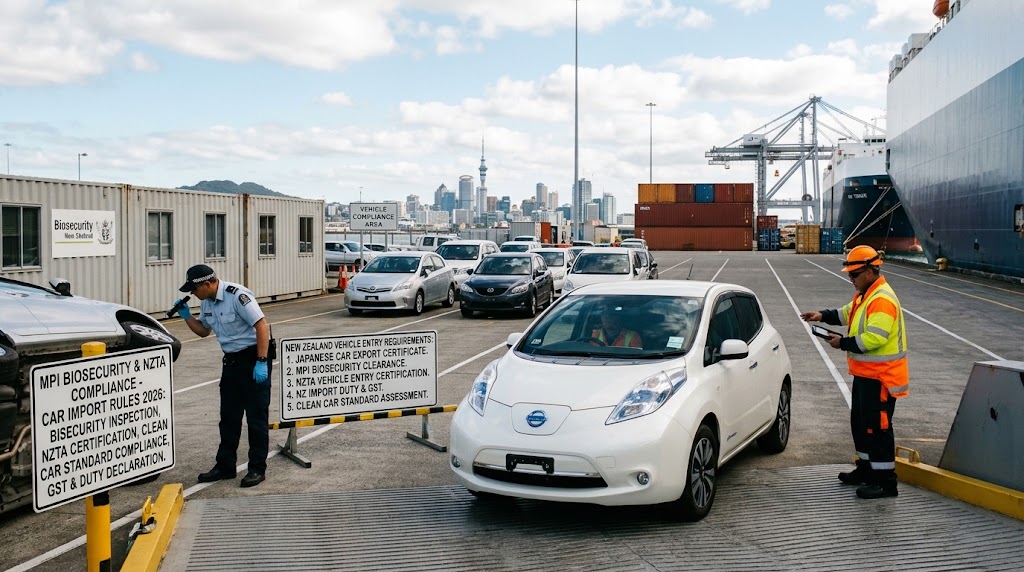
Short answer: yes. A used car from Japan can be registered in New Zealand if it passes a border inspection and biosecurity clearance, you can show it meets New Zealand’s vehicle standards, an entry certifier passes it, and you settle any Clean Car Standard charge. Customs duty on a car is 0%, and GST is 15%. We checked the points below against New Zealand Transport Agency (NZTA), Customs and Ministry for Primary Industries (MPI) pages on 13 November 2026.
Key points (checked 13 November 2026)
- Duty and GST: Customs lists a duty rate of 0% for a car and a GST of 15% on the price plus international freight, insurance, and any duty.
- Evidence from Japan: NZTA asks for the original export certificate (or completion inspection certificate) for a passenger car. It must carry a type designation number, and a “kai” mark after the model code is a warning.
- Border inspection: every used vehicle exported from Japan goes through an NZTA-approved inspector that is also an MPI-approved biosecurity system.
- Clean Car Standard: a light vehicle needs a CO₂ account. Under the Land Transport Act 1998, as amended by the Land Transport (Clean Vehicle Standard) Amendment Act 2025, a used car above its CO₂ target is charged NZ$6.00 per gram of excess CO₂ on the default Pay As You Go scheme in 2026 and 2027. The Act returns this rate to NZ$27.00 from 1 January 2028 unless it is changed again. NZTA calls the scheme the Clean Car Standard; the law calls it the Clean Vehicle Standard.
- Entry certification: an NZTA-appointed certifier inspects the car and issues the registration application and a warrant or certificate of fitness.
The steps, in order
NZTA says to do your research before you buy a car overseas. The steps below follow NZTA’s three stages.
- Check the car and talk to an entry certifier before you pay. NZTA recommends this, and also advises checking for a safety recall and talking to a customs or shipping agent about cost and timing.
- Check the Clean Car Standard. If you import a light vehicle, you must hold a Clean Car Standard CO₂ account. Without it the car cannot complete entry or be registered.
- Gather the evidence that the car meets New Zealand’s standards (next section). Some go to your shipping agent for the customs entry, and some go to the entry certifier.
- Use a shipping agent. NZTA says it is not mandatory but highly recommended.
- Border inspection. For a car from Japan, it happens in Japan, at the same time as the biosecurity management.
- Customs and biosecurity clearance at the New Zealand port.
- Entry certification by a certifier appointed by NZTA, once the car has been released to you.
- Settle the Clean Car Standard charge through your CO2 account, if one applies.
- Register and licence the car through an NZTA-approved agent if it will go on the road.
What NZTA asks for from Japan
If you import a used car from Japan, NZTA asks for evidence of ownership, of emissions, of frontal impact and overall standards, of fuel consumption, and of electronic stability control (ESC).
| Evidence | What NZTA says |
|---|---|
| Proof of ownership | The original documents that prove previous registration and an ownership trail back to the last registered owner in Japan |
| Passenger car, not a mini-vehicle | The original export certificate issued by Japan’s Ministry of Land, Infrastructure, Transport and Tourism (MLIT), with a type designation number (TDN) and a model code, or a completion inspection certificate |
| Mini-vehicle (660cc or less, Kei) | The original export certificate issued by the Light Motor Vehicle Inspection Organisation |
| Emissions standard | An export or completion inspection certificate showing an applicable emissions code at the start of the industry model code. If it does not, you need other evidence such as a statement of compliance |
| Frontal impact standard | A TDN on the export certificate, or a completion inspection certificate, or a statement of compliance |
| Fuel consumption | A fuel consumption certificate, which you can get from NZTA’s online tool if the car was registered in Japan and you hold the export or completion certificate |
| ESC | Check whether the car has it, using NZTA’s technical bulletin |
NZTA says a car that is not mini-sized complies with the frontal impact standard if it was made in Japan for the Japanese market on or after 1 January 1996, or made outside Japan on or after 1 April 1999 and accepted through Japan’s vehicle approval process. A mini-sized car under 660cc complies if it was made on or after 1 July 2000. A car older than 20 years, a “special interest” vehicle, and a vehicle belonging to someone emigrating or returning to New Zealand may not need to prove frontal impact compliance. Read NZTA’s page for the exact rules, because they differ by vehicle class and manufacture date.
The “kai” mark. NZTA tells importers to look for a kai mark after the model code on the certificate. It shows that the vehicle has been modified and may no longer meet the required standards. NZTA strongly recommends checking with an entry certifier.
If the certificate has no TDN, you need a statement of compliance, or a TDN exemption applied for through the entry certifier.
Border inspection and biosecurity
A border inspection by an NZTA-approved organisation checks the car’s VIN, make and model, and steering orientation. It also checks structural integrity, identifies damage and flags any further inspection needed at a compliance centre in New Zealand before entry certification.
NZTA says the approved organisations based in Japan are also MPI-approved vehicle biosecurity systems that all vehicles exported from Japan must go through. A used car from Japan therefore gets its border inspection while it is managed and inspected for biosecurity risk in Japan. NZTA’s list for Japan names JEVIC Company Limited, Automotive Technologies Limited, Bordercheck Limited and KMA (Autoterminal Japan). For a car that does not come from Japan, the inspection has to be done in New Zealand before Customs clearance.
MPI’s brown marmorated stink bug season starts on 1 September. It covers target vehicles exported on or after that date that arrive in New Zealand on or before 30 April. Japan is one of the risk countries listed in Schedule 3 of MPI’s import health standard, so during the season a car must be managed by an MPI-approved system or treated by an MPI-approved provider before it arrives. Check MPI’s page for the current risk countries, dates, and requirements before you ship. MPI’s notice on Japanese used vehicles, dated 2021, says it takes a sample at the port of first arrival and that if samples fail, it assesses the batch and may send it to a decontamination facility.
Duty, GST and Clean Car charges
| Charge | What the sources say |
|---|---|
| Customs duty | Customs lists a rate of 0% for a car (motorcycle 0%, motorhome 10%, vehicle for 10 or more people 5%) for goods that do not qualify for a concession. |
| GST | 15%, calculated on what you paid for the item, plus international freight, postage, and insurance, plus any import duty |
| Customs and MPI levy | Charged on each consignment. Your broker or freight forwarder pays it and may pass it on. The rate is on Customs’ goods levies page. |
| Clean Car Standard | A charge if the car’s CO₂ value is above its target, and a credit if it is below. For 2026 and 2027, the Land Transport Act 1998 sets the used-vehicle charge at NZ$6.00 per gram of excess CO2 on Pay As You Go (section 182). On the Fleet Average scheme it is NZ$7.50 per gram of excess CO2 across the fleet, multiplied by the number of used vehicles (section 177). From 1 January 2028 the rates rise to NZ$27.00 and NZ$33.75 unless the law changes. New row to add: NZ$19.53 excluding GST (NZ$22.46 including GST). You pay it with the registration fee when a light vehicle is registered in New Zealand for the first time (regulation 32 of the Land Transport (Clean Vehicle Standard) Regulations 2022, in force from 1 July 2025). NZTA calls it the CCS admin fee. |
| Entry certification and registration | Fees apply to both. NZTA lists the common registration fees on its site. |
The Clean Car Standard target depends on the car, and your CO₂ account calculates the charge or credit. Credits have no monetary value, but you can use them to offset charges. A new CO₂ account starts on Pay As You Go, where any charge for a car must be settled before it is registered. Importers can apply to NZTA to move to the Fleet Average scheme.
Here is an illustration with round numbers, not a quote. If a car costs NZ$10,000 and freight and insurance come to NZ$1,500, and there is no duty, GST is 15% of NZ$11,500, which is NZ$1,725.
Entry certification and registration
The entry certifier checks that the car meets the safety and emissions standards for when it was made, establishes proof of ownership, inspects the car for repairs or specialist certification, and issues the application to register (form MR2A) and a warrant or certificate of fitness. NZTA says to contact a certifier when you are considering a specific car. If the car has major damage, it may have to go to a repair certifier first.
Entry certification takes place after border inspection and customs and biosecurity clearance. Dealers and repairers with trade plates may drive an uncertified car on a conditional permit to the certifier. Private importers have to transport it, for example, on a trailer. After registration and licensing by an NZTA-approved agent, the car can be driven legally, and the usual warrant of fitness rules apply.
Before you buy: a checklist
- The certificate: Does the car have an original export or completion inspection certificate with a TDN and no kai mark?
- An entry certifier: have you asked one about this exact car?
- The recall check: has the car been checked for a safety recall?
- The CO₂ value: have you checked the Clean Car Standard charge or credit for the model?
- A shipping agent who handles the customs entry.
- ESC and frontal impact: can you show the car meets the standards for its class and year?
- The season: have you checked MPI’s stink bug dates for your shipping month?
- A budget with GST, the levy, any CCS charge, certification fees and registration.
More on importing a Japanese car
See our New Zealand page for stock, and our guide to reading a Japanese auction sheet before you bid.
Frequently asked questions
Can I import a car from Japan to New Zealand?
Yes. It needs to pass the border inspection and biosecurity clearance, meet NZTA’s standards with the right evidence, and be passed by an entry certifier.
Is there an age limit for a used car?
There is no fixed age limit. In practice, the car must have electronic stability control and meet the current exhaust emissions standard (for a petrol car, Euro 5, Japan 2005 Low Harm, Japan 2018 or an equivalent), which rules out many older models. A car more than 20 years old may not need to prove frontal impact compliance. The evidence you need depends on the vehicle class and date of manufacture, so check the exact car with an entry certifier.
What is the duty on a car from Japan?
Customs lists 0% for a car that does not qualify for a concession. GST of 15% still applies.
What is a kai mark?
It is a mark after the model code on a Japanese certificate. NZTA says it shows the vehicle has been modified and may no longer meet the standards, and strongly recommends checking with an entry certifier.
Do I need a shipping agent?
NZTA says it is not mandatory but highly recommended.
How much is the Clean Car charge?
It depends on the car’s CO2 value against its target. For 2026 and 2027, the Land Transport Act 1998 sets the Pay As You Go charge for a used vehicle at NZ$6.00 per gram of CO2 above the target, and a car below the target earns a credit. Your CO2 account calculates the charge. The rate is due to return to NZ$27.00 from 1 January 2028 unless the law changes.
How long does it take?
We found no official total time, so we do not give one.
Last checked 13 November 2026
We wrote this guide on 13 November 2026 from the official NZTA, Customs and MPI pages and the New Zealand legislation listed below. NZTA and MPI update their pages often, so check them again before you ship. Pay particular attention to MPI’s stink bug season (1 September to 30 April) and to the Clean Car Standard charges. The current reduced rates are fixed by law for 2026 and 2027 only, and on 21 August 2026 the Government announced that used imports will get separate CO2 targets from 2028. NZTA and MPI update their pages often, so check them again before you ship. Pay particular attention to MPI’s stink bug season and the Clean Car Standard rates, which change each year.
Sources
- NZ Transport Agency Waka Kotahi, The importing process: what you need to do
- NZTA, Clean Car Programme step and Credits, charges and payments
- NZTA, Used vehicles from Japan
- NZTA, Border inspection, Entry certification and Registration and licensing
- New Zealand Customs Service, Import allowances and charges
- Ministry for Primary Industries, Importing vehicles, machinery, and parts and brown marmorated stink bug requirements
Ready to Import Your Next Vehicle?
Qualitex Trading Japan provides direct access to over 100,000+ Japanese used cars at auction prices. We handle bidding, inspection, and global shipping.