By Qualitex Trading Technical Editorial Team | Japan Used Vehicle Export Insights
Advanced Driver Assistance Systems (ADAS)—including autonomous emergency braking (AEB), adaptive cruise control, and lane-keep assist—have become primary purchasing criteria for international car buyers importing late-model Japanese vehicles. However, behind the steering wheel badges, Japanese automakers adopted sharply contrasting philosophies regarding sensor hardware.
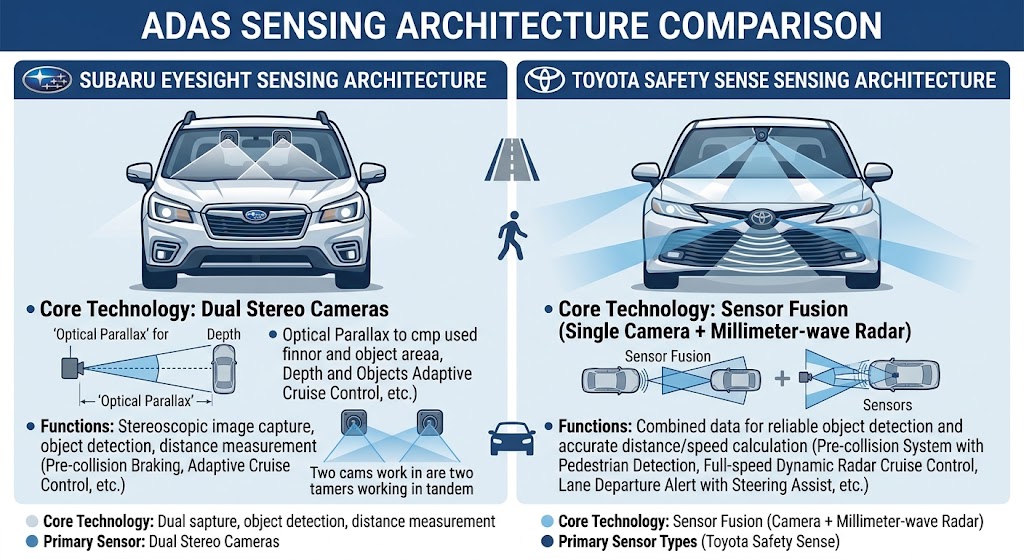
While Toyota standardized on multi-sensor data fusion (pairing optical monocular cameras with millimeter-wave radar), Subaru took a pioneering path by relying almost exclusively on dual stereoscopic computer vision. For automotive importers, fleet managers, and dealerships bidding on Japanese auto auction platforms, understanding these differing sensor designs is critical for evaluating long-term vehicle maintenance, windshield replacement feasibility, and real-world durability in export destinations.
1. Core Sensing Principles & Hardware Architectures
Subaru EyeSight: Pure Stereoscopic Optical Parallax
First introduced commercially in Japan in 2008 and continuously updated across versions 2, 3, Touring Assist, and next-generation wide-angle systems, Subaru EyeSight functions like human binocular vision.
- Sensing Hardware: Two high-resolution CMOS color cameras mounted symmetrically behind the upper windshield on either side of the rearview mirror, separated by a baseline distance of roughly 30 to 35 cm. (Newer models add a third wide-angle monocular camera for wider pedestrian detection at intersections.)
- Depth Calculation (Parallax): The system does not emit radio or laser signals. Instead, it compares the slight horizontal pixel displacement between identical points in both camera images (optical parallax) to construct a real-time, high-density 3D depth map of the road ahead.
- Object Classification: Because EyeSight captures full-color RGB data, it easily identifies brake lights, lane boundary markings, pedestrians, bicycles, and static debris that lack strong metallic radar reflections. It also features Pre-Collision Throttle Management, preventing sudden acceleration if the cameras detect an obstacle in front of the car when shifting from Park.
Toyota Safety Sense (TSS): Sensor Fusion (Camera + Millimeter-Wave Radar)
Toyota’s approach, scaled across millions of mass-market models from the Yaris and Corolla to the RAV4, Harrier, and Lexus lineup (TSS-P, TSS 2.0, 2.5, and 3.0), utilizes complementary sensor technologies.
- Sensing Hardware: A forward-facing monocular optical camera mounted inside the windshield glass paired with a 77 GHz millimeter-wave radar transceiver positioned directly behind the front grille or Toyota emblem. (High-end Lexus Teammate platforms supplement this with LiDAR and corner micro-radars.)
- Data Fusion Engine: The optical camera handles 2D spatial classification—reading speed limit signs, tracking lane paint, identifying vehicle outlines, and distinguishing human pedestrians. Meanwhile, the millimeter-wave radar sends radio frequency waves ahead, measuring time-of-flight and Doppler shift to calculate exact distance and relative velocity with millisecond precision.
- Intervention Dynamics: The onboard ADAS ECU fuses the camera’s visual identification with the radar’s velocity and ranging data. If both confirm an obstacle closing at high differential speeds, the vehicle triggers autonomous pre-collision braking.
2. Engineering & Technical Comparison Matrix
| Specification / Attribute | Subaru EyeSight (Stereo Vision) | Toyota Safety Sense (Sensor Fusion) |
|---|---|---|
| Primary Hardware | Dual Color CMOS Stereo Cameras | Monocular Camera + 77 GHz Millimeter-Wave Radar |
| Distance / Depth Sensing Method | Mathematical triangulation via optical parallax | Radio-wave time-of-flight & Doppler velocity measurement |
| Adverse Weather Penetration (Fog, Heavy Rain) | Limited: If the human eye or wipers cannot see through the glass, EyeSight temporarily disables. | Superior: Millimeter radar easily cuts through heavy rain, road spray, dust, and thick fog. |
| Non-Metallic Hazard Detection | Exceptional: Detects wooden barriers, cardboard boxes, animals, and clothing colors natively. | Moderate to High: Dependent on the optical camera; radar alone struggles with low-reflectivity obstacles. |
| Sensor Placement Vulnerability | Zero Bumper Exposure: Entire assembly is protected inside the climate-controlled cabin. | Front Bumper Exposed: Grille radar is vulnerable to minor fender benders and stone impacts. |
| Popular Export Auction Models | Forester (SJ5/SK9), Outback (BS9/BT5), Levorg (VM4/VN5), XV | Corolla (NRE210), RAV4 (MXAA54), Harrier (AXUH80), Prius (ZVW50/60) |
3. Auction Inspection & Destination Market Serviceability
1. Windshield Damage & Calibration Costs
Because both systems look through the front windshield, chipped or cracked glass on auction stock is a major consideration. When replacing a damaged windshield in an export market, both EyeSight and TSS require recalibration using optical target boards. However, Subaru stereo cameras are exceptionally sensitive to glass optical distortion. Using non-OEM or low-grade aftermarket replacement glass can introduce optical refractive errors, causing EyeSight to fail self-diagnostics or trigger false emergency braking events.
2. Front-End Collision Repairs & Radar Alignment (Toyota)
When bidding on Grade R or 3.5 accident-repaired Toyota auction vehicles, check whether the front bumper or radiator support was repaired. If the front millimeter-wave radar bracket behind the grille emblem is bent even 2–3 degrees off-axis, Dynamic Radar Cruise Control will either drift out of tracking or disengage with an error light. Recalibrating radar modules requires specialized Doppler reflectors and manufacturer scan tools.
3. Cabin Cleaning Precautions (Subaru)
EyeSight cameras are exposed directly beneath the vehicle headliner. When used vehicles are detailed or fumigated prior to RoRo export, detailers must never touch, wipe, or spray chemicals directly onto the EyeSight camera lenses. The anti-reflective lens coatings can scratch easily, requiring an expensive dual-camera assembly replacement if clouded.
Frequently Asked Questions (FAQ)
1. Does Subaru EyeSight stop working at night or in direct sunlight?
EyeSight operates effectively at night using the vehicle’s headlight illumination to track objects, lane lines, and tail lamps. However, driving directly into intense low-angle sunrise or sunset glare can temporarily blind the optical sensors, causing the dashboard to illuminate an amber “EyeSight Off” warning until camera contrast normalizes.
2. Can I install an aftermarket bull bar or winch on a Toyota TSS-equipped SUV?
Installing heavy-duty steel bull bars, brush guards, or center winches on models like the Land Cruiser Prado or Hilux can obstruct the 77 GHz millimeter-wave radar transceiver located behind the front grille badge. Importers modifying vehicles must ensure the accessory includes a radar-compatible polycarbonate window or relocation provisions.
3. Why did Subaru avoid radar for so many years?
Subaru engineers prioritized cost efficiency and fine spatial contour recognition. By perfecting stereo camera parallax algorithms, Subaru achieved industry-leading emergency braking ratings from safety agencies like IIHS and JNCAP without passing on the expensive hardware cost of radar units to the consumer.
4. Which ADAS system is easier to maintain in remote or developing markets?
Toyota Safety Sense is generally easier to live with across rugged international regions where windshield replacement glass may only be available from aftermarket suppliers. Because TSS relies heavily on its independent grille radar for longitudinal braking and distance control, minor windshield imperfections affect cruise control less severely than on pure vision systems.
Source Inspected ADAS-Equipped Vehicles Direct from Japan
At Qualitex Trading Co. Ltd, we inspect radar mounts, windshield integrity, and diagnostic warning lights across every major auto auction in Japan. Whether you need late-model Toyota Safety Sense inventory or camera-verified Subaru EyeSight crossovers, our export specialists ensure your vehicles arrive in top condition with full pre-export verification.
Ready to Import Your Next Vehicle?
Qualitex Trading Japan provides direct access to over 100,000+ Japanese used cars at auction prices. We handle bidding, inspection, and global shipping.