By Qualitex Trading Technical Editorial Team | Japan Used Vehicle Export Insights
For decades, internal combustion engine design was constrained by a fixed mechanical compromise: camshaft geometry that produced smooth idle and low-end fuel economy suffocated the engine at high RPM, while an aggressive racing cam resulted in rough idling, poor emissions, and an unusable low-RPM torque band.
Japanese automotive engineers shattered this trade-off in the late 1980s and 1990s through variable valvetrain innovation. Honda, Toyota, and Nissan each engineered unique solutions ranging from discrete cam profile swapping to continuous hydraulic cam phasing and stepless variable valve lift linkage assemblies. For international vehicle importers sourcing high-performance classics and durable commercial workhorses from Japanese auto auctions, understanding these valvetrain mechanisms is essential for pre-purchase evaluation and maintenance planning.
1. Technical Valvetrain Mechanisms & Principles
Honda VTEC: The Discrete Hydraulic Profile Switcher
Introduced in 1989 on the Integra XSi with the legendary B16A engine, VTEC (Variable Valve Timing and Lift Electronic Control) was the world’s first mass-market valvetrain capable of dynamically altering both valve lift and duration.
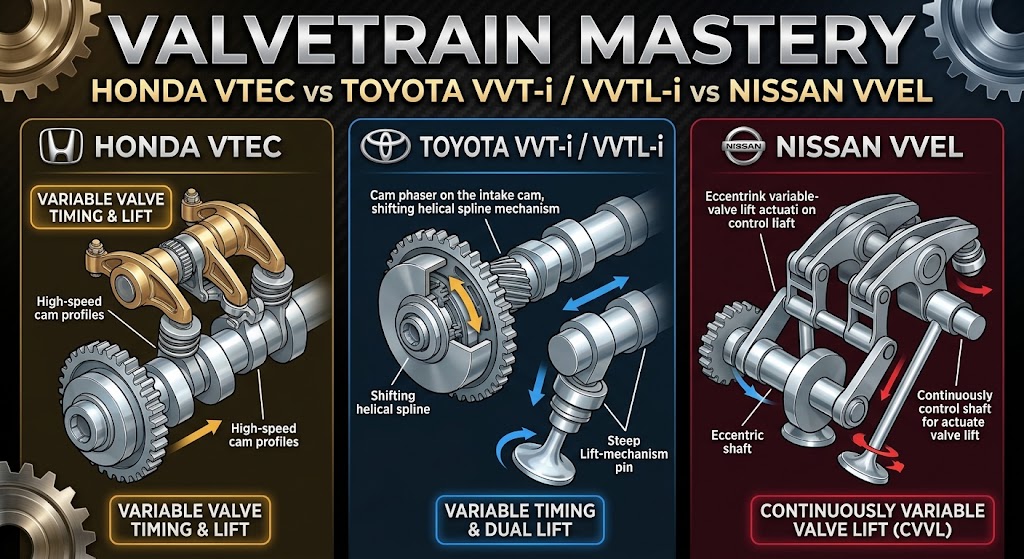
- Mechanical Architecture: Each cylinder pair incorporates three cam lobes on the camshaft matched to three independent rocker arms. The two outer lobes feature mild lift and short duration profiles optimized for low-RPM torque, high intake charge velocity, and clean combustion. The center lobe features an aggressive, high-lift, long-duration racing profile.
- Engagement Logic: Rocker arms operate independently at low RPM. When engine parameters (RPM, coolant temperature, engine load, and vehicle speed) hit target thresholds—typically between 4,800 and 6,000 RPM—the engine control module energizes the VTEC oil control solenoid. Hydraulic oil pressure pushes a set of steel synchronizer pins across the rockers, locking all three arms together. The valves are instantly forced to follow the aggressive center racing lobe.
- Export Legacy: Renowned for bulletproof mechanical reliability and an iconic acoustic crossover, powering auction favorites like the Civic Type R (EK9, FD2), Integra Type R (DC2, DC5), and S2000 (AP1/AP2).
Toyota VVT-i & VVTL-i: Continuous Phasing to Dual Profile Modulation
Toyota tackled breathing efficiency through progressive stages of camshaft manipulation, evolving from stepped systems into continuous hydraulic advance:
- VVT-i (Variable Valve Timing with intelligence): Unlike early VTEC which switched cam lobes, VVT-i uses a computer-controlled hydraulic vane actuator integrated directly into the camshaft pulley. It continuously advances or retards intake camshaft timing relative to the crankshaft by up to 50–60 degrees, optimizing valve overlap dynamically across every single RPM increment.
- VVTL-i (Variable Valve Timing and Lift with intelligence): Co-developed with Yamaha for the high-revving 2ZZ-GE engine (found in the Celica SS-II, Corolla RunX Z Aero, and Matrix XRS), this system merged continuous VVT-i cam phasing with a rocker-arm locking slipper pin mechanism similar to VTEC. It operates on both intake and exhaust camshafts, delivering continuous mid-range torque tuning alongside an aggressive second-stage cam “lift” transition above 6,200 RPM.
Nissan VVEL: Stepless Variable Valve Event and Lift
Unveiled on the VQ37VHR engine (powering the Nissan Skyline 370GT and Fairlady Z Z34), VVEL represents one of the most mechanically sophisticated valvetrain designs ever mass-produced, rendering the traditional throttle plate virtually obsolete for primary airflow control.
- Mechanical Architecture: VVEL eliminates fixed cam lobes driving direct tappets or traditional rocker arms. Instead, an eccentric drive cam rotates inside a link arm connected to a rocker arm and an output cam. A dedicated high-speed DC stepper motor rotates a central control shaft fitted with eccentric control cams.
- Operation: Rotating the control shaft continuously alters the pivot fulcrum of the rocker arm. This allows the engine to vary valve lift continuously from as little as 0.7 mm up to a massive 12.0 mm, simultaneously adjusting valve open duration without stepped transition points.
- Thermodynamic Benefit: Because intake airflow is metered directly at the valve opening rather than downstream at a vacuum throttle plate, intake pumping losses drop by up to 10%, delivering instant throttle response and higher fuel efficiency.
2. Valvetrain Architecture Comparison Matrix
| Attribute | Honda VTEC | Toyota VVTL-i | Nissan VVEL |
|---|---|---|---|
| Primary Mechanism | Hydraulic pin locks rocker arms onto high-profile cam lobe | Continuous hydraulic sprocket phasing + rocker slipper lock | DC stepper motor rotating eccentric link shaft mechanism |
| Timing Adjustment | Discrete / Step-based (Later i-VTEC added continuous VTC) | Continuous phasing (Intake) + Discrete lift (Intake/Exhaust) | Continuous timing advance paired with stepless lift |
| Lift Adjustment | 2 Discrete Steps (Mild / Aggressive) | 2 Discrete Steps (Low / High lift) | Infinite / Stepless Variable (0.7 mm to 12.0 mm) |
| Throttle Response | Direct, high-RPM top-end kick | Broad mid-range with distinct top-end engagement | Instantaneous; intake metered directly at cylinder head |
| Oil Quality Sensitivity | High (Hydraulic solenoid and spool valve require clean oil) | Extreme (Rocker lift bolts wear out if oil degrades) | Very High (Multi-link bearings and stepper actuators) |
| Benchmark Export Models | Civic (EK4/EK9/EP3/FD2), Integra (DC2/DC5), Accord Euro R (CL7) | Celica SS-II (ZZT231), RunX Z Aero (ZZE123), Voltz (ZZE137) | Skyline 370GT (V36/KV36), Fairlady Z (Z34), Fuga 370GT (KY51) |
3. Auction Inspection & Maintenance Guide for Importers
1. Honda VTEC Solenoid Spool Valve Gasket Leaks
When inspecting classic or modern VTEC engines at Japanese auto auctions, the primary inspection point on the rear upper cylinder head is the VTEC spool valve assembly. The internal mesh screen filter frequently clogs with hardened oil sludge if previous owners stretched maintenance intervals. If this screen clogs, oil pressure fails to reach the critical threshold required to push the synchronizer pins, locking the engine out of high-cam operation.
2. Toyota VVTL-i “Lift Bolt” Wear on the 2ZZ-GE
On Celica ZZT231 and Corolla RunX Z Aero models, the rocker shaft is secured by small specialized “lift bolts” with narrow tapered heads. On engines built before mid-2002, or those run on degraded engine oil, these bolts can snap or wear flat. When sheared, the rocker shaft slips out of alignment, preventing the high-lift rocker pins from sliding into position and triggering a dead spot above 6,000 RPM. Always verify clean rev-out performance up to 8,000 RPM.
3. Nissan VVEL Actuator Motor Calibration & Sub-Harnesses
Because Nissan VVEL relies on precise electromechanical sensors (VVEL position sensors and high-speed DC actuator motors on each cylinder bank), vehicles that have sat dormant in auction staging yards with dead batteries can trigger throttle body and VVEL synchronization faults (such as DTC P1089 or P1090). Importers must ensure ECU adaptive relearn procedures are conducted using professional diagnostic scan tools when recommissioning these vehicles.
Frequently Asked Questions (FAQ)
1. Can a vehicle with VTEC or VVTL-i run safely on regular lower-octane pump fuel?
Naturally aspirated high-revving performance variants—such as Honda’s B16B, B18C, K20A, and Toyota’s 2ZZ-GE—feature static compression ratios ranging between 10.8:1 and 11.5:1. In destination markets, they require premium high-octane gasoline (minimum 95–98 RON). Lower-grade fuel will force the knock sensor to aggressively retard ignition timing, causing loss of power and potential pre-ignition damage on high cam profiles.
2. What is the difference between classic Honda VTEC and modern i-VTEC?
Classic VTEC (B-series, H-series, early C-series) only switched between two fixed cam profiles at a specific RPM trigger. i-VTEC (introduced on K-series and R-series engines) added VTC (Variable Timing Control), an electro-hydraulic cam sprocket gear on the intake side that continuously rotates the camshaft relative to crank timing, combining continuous low-end torque adjustability with high-RPM profile switching.
3. Why did Nissan choose complex VVEL over simple dual VTC cam phasers?
Dual VTC only shifts cam timing forward or backward; it cannot alter the physical distance the valve opens or how long it stays open. By utilizing mechanical links to vary valve lift steplessly down to 0.7 mm, Nissan eliminated the vacuum throttling loss of a closed throttle butterfly plate, significantly improving cylinder scavenging, emissions compliance, and high-RPM airflow in large displacement V6 engines.
4. How often should engine oil be changed on variable valvetrain Japanese engines?
Because all three systems depend strictly on clean oil pressure and precision micro-tolerances to actuate hydraulic locking pins and control solenoids, engine oil changes should never exceed 5,000 km to 7,000 km. Using the manufacturer-recommended viscosity (typically 5W-30 or 0W-20 on modern units) ensures rapid hydraulic pressure buildup upon cold startup.
Source Authentic JDM Performance Engines & Vehicles Direct from Japan
At Qualitex Trading Co. Ltd, we specialize in sourcing and inspecting premium Japanese vehicles across all major auto auctions. From rev-happy VTEC Honda Type R hatches to clean Nissan VVEL sports coupes and dependable Toyota family cruisers, our bilingual team provides complete auction sheet verification, on-site mechanical inspections, and direct international shipping to your home port.
Ready to Import Your Next Vehicle?
Qualitex Trading Japan provides direct access to over 100,000+ Japanese used cars at auction prices. We handle bidding, inspection, and global shipping.