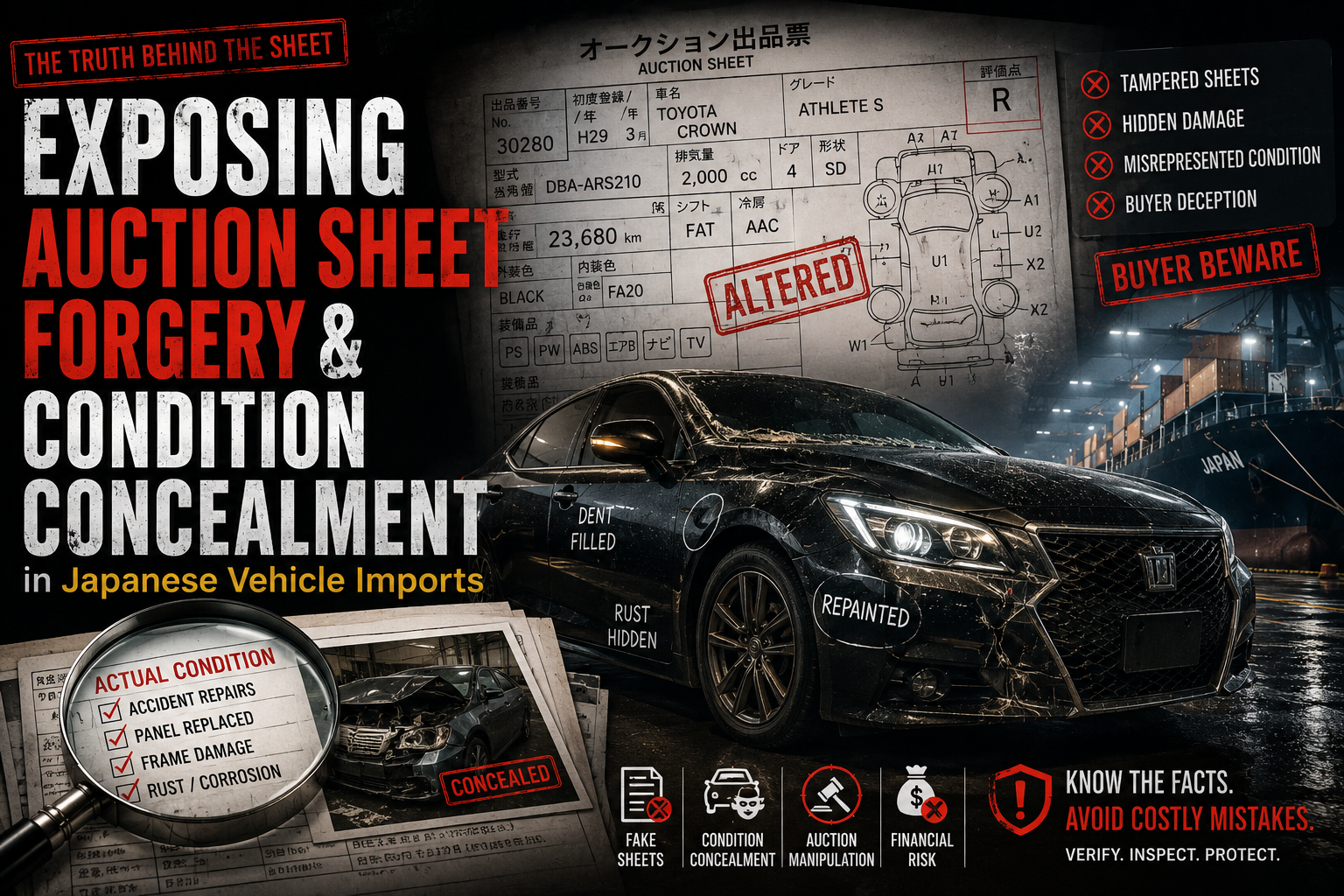
In the global used car market, the Japanese automotive auction sheet (Shuppyo) is widely regarded as the gold standard of vehicle condition transparency. Rigorous third-party inspectors at major Japanese auction houses—such as USS, TAA, CAA, JU, and ARAI—evaluate every mechanical component, body panel, and structural frame point before assigning an official grade.
However, the integrity of this system is increasingly being undermined by dishonest brokers and fly-by-night exporters through Auction Sheet Forgery and Physical Condition Concealment. By digitally altering accident grades and concealing structural frame damage or severe rust, unscrupulous operators sell compromised salvage units at premium market prices.
As a licensed Japanese motor vehicle exporter and accredited member of JUMVEA, Qualitex Trading Co. Ltd. is committed to total transparency. In this guide, we expose the exact methods scammers use to falsify auction sheets, the physical concealment tricks applied in export yards, and how to verify original auction records before you buy.
1. How Auction Sheet Forgery Works
Auction sheet forgery occurs when an intermediary buys low-grade inventory at Japanese dealer auctions and modifies the official inspection sheet before emailing it to an overseas buyer.
The Three Most Common Digital Forgery Tactics:
- Grade Whitewashing: Changing the overall condition grade from Grade R / RA (Accident / Repaired) or Grade 3 / 3.5 (Heavy Wear / Minor Rust) to a clean Grade 4 or 4.5.
- Erasing Japanese Inspector Kanji Notes: Removing critical handwritten notes from the inspector’s remarks section (Kensa-in Hokoku), such as:
修復歴あり(Shūfuku-reki ari – Prior Structural Repair / Accident History)下回り腐食 / サビ(Shitamawari Fushoku / Sabi – Underbody Structural Rust / Corrosion)冠水歴(Kansui-reki – Flood Damaged / Submerged Vehicle)メーター交換歴あり(Mētā Kōkan-reki ari – Odometer Cluster Replaced)
- Clearing Diagram Defect Symbols: Erasing panel replacement markers (
XX), severe deep dents (U3), significant scratches (A3), or heavy wave repaints (W3) from the vehicle body diagram on the sheet.
2. Physical Condition Concealment in Export Yards
Digital forgery is often accompanied by physical masking in holding yards prior to container loading or roll-on/roll-off (RoRo) shipping:
Underbody Bitumen Masking (Black Paint Over Rust):
Vehicles sourced from snowy northern prefectures (Hokkaido, Tohoku, Hokuriku) often suffer from structural road-salt corrosion (Grade C / S rust). Unethical operators spray heavy black bitumen undercoating directly over flaking frame rails to hide rust from pre-shipment photographs.
Temporary Diagnostic Trouble Code (DTC) Clearing:
Using OBD-II scanners, sellers clear “Check Engine”, Hybrid System Warning, or ABS dashboard lights right before taking export staging photos. The fault codes inevitably reappear once the buyer unloads the car at the destination port.
Cosmetic Panel Shimming & Quick-Bondo Fills:
Severe front-end structural collisions that distorted the core radiator support or pillar pillars are given superficial body filler (bondo) and fast paint blending to appear straight on camera, leaving the underlying chassis unaligned and unsafe.
3. Authentic vs. Forged Inspection Documentation
| Audit Feature | Manipulated / Forged Sheet | Authentic Document (Qualitex Standard) |
|---|---|---|
| Auction Grade Consistency | Edited to Grade 4/4.5 with mismatched font weight or pixel distortion. | Native auction house typography matching official USS, TAA, CAA, or JU formats. |
| Inspector Remarks Section | Completely blank or artificially smoothed to hide Kanji repair terms. | Full Japanese handwritten inspector notes accompanied by certified translations. |
| Database Verifiability | Seller refuses to share lot number or auction date; data missing from auction archives. | Directly verifiable via auction house archives matching exact date, hall, and lot number. |
| Underbody Transparency | Fresh black paint concealing frame rails without original bare-metal photos. | High-resolution unpainted undercarriage photos showing original factory condition. |
4. 5 Steps to Verify an Auction Sheet Before You Wire Funds
- ✔ 1. Request the Unedited Japanese Sheet with Lot Details: Insist on receiving the raw high-resolution scan of the auction sheet displaying the Auction Hall Name, Date, and Lot Number.
- ✔ 2. Cross-Verify Against Third-Party Auction Records: Run the complete chassis number (VIN) through established auction record archives (e.g., Aleado, CarVX, or direct Japanese auction historical feeds) to verify historical sale grades and logged mileage.
- ✔ 3. Translate Handwritten Kanji Notes: Never ignore the handwritten Japanese text on the bottom and right margins. Use OCR translation tools or professional translators to confirm absence of repair (修復) or rust (腐食) disclosures.
- ✔ 4. Look for Image Compression Artifacts: Zoom in on the overall Grade number and car diagram. If the surrounding background shows blurred rectangular compression blocks while the rest of the sheet has fine grain, the file has been edited.
- ✔ 5. Work Exclusively with Accredited JUMVEA Exporters: Deal only with registered exporters who are bound by JUMVEA trade compliance and legal regulations in Japan.
5. Frequently Asked Questions (FAQs)
What does “Grade R” or “Grade RA” mean on a Japanese auction sheet?
Grade R (or RA) signifies that the vehicle has a history of structural repair resulting from an accident, collision, or mechanical overhaul. While some Grade R cars are repaired professionally to factory standards, they are priced substantially lower than Grade 4+ vehicles. Disguising a Grade R car as Grade 4 is a direct fraud. Can pre-shipment inspections (JEVIC, QISJ, EAA) detect disguised rust or accident damage?
Yes. Pre-shipment inspection agencies enforce strict roadworthiness and structural integrity criteria mandated by destination countries (such as Kenya, Tanzania, New Zealand, and Jamaica). Inspectors routinely use thickness gauges and mechanical probes to detect structural weakness concealed beneath fresh underbody paint. What happens if my imported vehicle arrives with structural rust or undisclosed accident history?
In countries with strict road safety standards (such as New Zealand’s Waka Kotahi/NZTA compliance or Australia’s entry standards), structural rust or compromised repair work will result in compliance failure. The vehicle may be rejected for road registration, requiring costly certified frame repairs or total scrapping. How does Qualitex Trading Co. Ltd. protect buyers against auction sheet tampering?
At Qualitex Trading Co. Ltd., we provide buyers with complete, unedited auction sheets directly from Japanese auction house portals, along with accurate English translations of inspector comments. We independently inspect vehicles prior to shipment to ensure the physical condition matches the official documentation exactly.
6. Official References & Regulatory Verification Authorities
- Japan Used Motor Vehicle Exporters Association (JUMVEA): Official trade body recognized by Japan’s Ministry of Economy, Trade and Industry (METI) promoting fair trade and vehicle disclosure compliance. (JUMVEA Official Portal)
- Japan Export Vehicle Inspection Center (JEVIC): International pre-shipment inspection authority providing pre-export roadworthiness, structural rust, and odometer certification. (JEVIC Inspection Standards)
- Quality Inspection Services Japan (QISJ): Accredited pre-shipment vehicle inspection organization verifying technical condition and export documentation for global destination markets. (QISJ Verification Portal)
- Waka Kotahi / New Zealand Transport Agency (NZTA): Technical guidelines and border enforcement directives regarding structural corrosion, repair verification, and salvage declarations in imported used vehicles.
Get 100% Verified Auction Reports with Qualitex Trading Co. Ltd.
Import with complete confidence. Access genuine, unedited Japanese auction sheets, verified mileage reports, and direct corporate accountability from a registered JUMVEA exporter. Request a Verified Vehicle Assessment
Ready to Import Your Next Vehicle?
Qualitex Trading Japan provides direct access to over 100,000+ Japanese used cars at auction prices. We handle bidding, inspection, and global shipping.