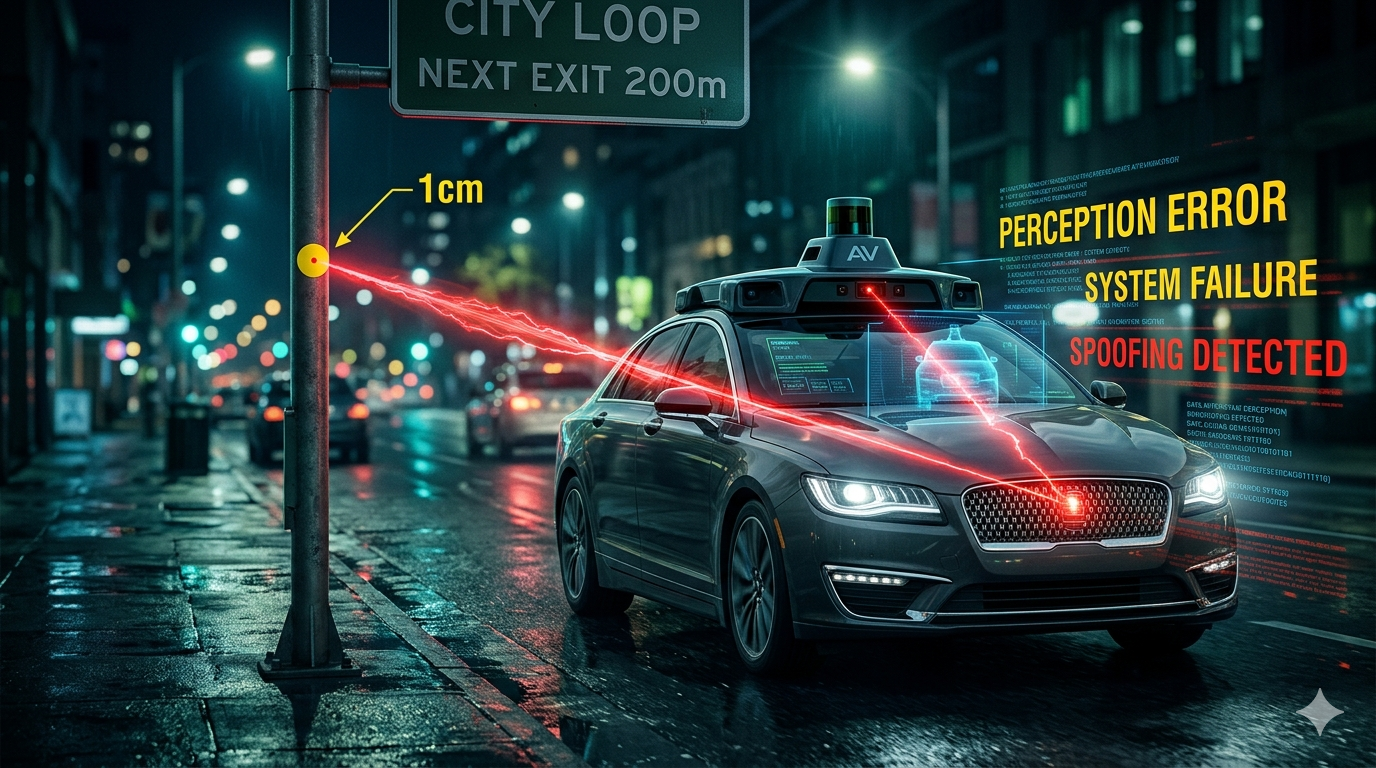
Imagine your family is cruising down a multi-lane highway at 70 miles per hour. Your car’s “auto-steer” and “adaptive cruise control” are engaged, fused by a high-tech array of cameras and radar that you’ve been told is safer than any human driver. Security researchers have shown that if sufficient safeguards are not in place, vulnerabilities in connected vehicle systems can open doors to safety-critical functions.
The car’s computer, the path of least resistance isn’t the center of the lane anymore—it’s a phantom trajectory that sends your vehicle directly into oncoming traffic. [1, 2]
This is the terrifying reality of the software-defined vehicle. Features like lane assist, adaptive cruise control, and self-parking are part of modern ADAS (Advanced Driver Assistance Systems). These technologies are marketed as conveniences but also represent software interfaces connected to critical vehicle functions.
When a computer can control your steering wheel and brakes, a network breach is no longer a data theft issue—it is a physical safety crisis. [3, 1]
The rapid growth of the advanced driver assistance systems market has accelerated the adoption of features such as lane centering, adaptive cruise control, and automated parking. As these systems become more common, cybersecurity and software reliability are increasingly important considerations alongside convenience and safety.
The Two-Stage Attack on Reality
Recent doctoral research has exposed how easily these “smart” systems can be weaponized. Using a “two-stage attack” methodology, researchers successfully tricked the Tesla with Autopilot system into making lethal steering decisions without the driver ever noticing. The process is mathematically optimized to exploit the over-sensitivity of the AI’s relationship with reality. [1]
- Stage 1: Digital Perturbation: Researchers access the vehicle’s “vision” binary to find the exact digital markers that the AI is most sensitive to. [1]
- Stage 2: Physical Deployment: These digital markers are translated into real-world road markings—stickers as narrow as 1 centimeter—placed on the asphalt. [1]
In real-world crossroads testing, these tiny, inconspicuous stickers misled a vehicle in auto-steer mode, resulting in a considerable lane-tracking deviation in the tested circumstances. [1] The AI didn’t just fail; it followed a “fake lane” that it believed was safer than the real one.
The Crisis of Planning-Control Inconsistency
Even if the software “plans” a safe path, there is no guarantee the car will follow it. This is known as “planning-control inconsistency.” In a landmark evaluation of the industrial-grade Apollo ADS platform, researchers identified 14 practical bugs in the control module. [1] Researchers found software problems that could impact trajectory tracking performance, including timing, synchronization, and control behavior.
In basic testing, this state-of-the-art controller failed to complete simple maneuvers, like a sharp right turn, 80% of the time. [1] When you combine these software defects with the fact that automotive cyber incidents more than doubled in 2025—with attackers now seizing individual cars for ransom—the “convenience” of autonomous features looks more like a liability.
These challenges are not limited to passenger cars. As manufacturers develop autonomous commercial vehicles for logistics, freight, and public transportation, ensuring robust cybersecurity and dependable control systems becomes even more critical because software failures could affect larger vehicles operating in complex environments.
ADAS, Tesla Autopilot & the Growing Cybersecurity Risks of Connected Vehicles
A network breach in a connected car is not a loss of privacy; it is a loss of momentum. Until vehicle architectures are mathematically provably secure—meaning there is no logical path from a web browser to a steering actuator—the only safe option is to opt out. [3, 1]
I am sticking with “dumb” vehicles because a mechanical steering column is a physical link, not a network node. A hydraulic brake is a certainty of physics, not a software request that can be intercepted or delayed by 10 seconds by a buggy controller. [1] In an analog car, the only driver is the human behind the wheel.
As the advanced driver assistance systems market continues to grow, manufacturers are investing heavily in safer and more resilient vehicle software. At the same time, ongoing research into connected vehicles and autonomous commercial vehicles highlights the importance of balancing innovation with cybersecurity and system reliability.
At Qualitex Trading Co. Ltd., we understand that for many of our global clients, the mechanical durability and analog reliability of a trusted Japanese vehicle are what matter most. As the world rushes toward unproven “smart” technology, we remain committed to exporting the vehicles that you, and only you, control.
Frequently Asked Questions
1. Can a 1 cm sticker really cause a car accident?
Yes. Research on Tesla Autopilot showed that mathematically optimized stickers as narrow as 1 cm can trick lane detection systems into “seeing” fake lanes, causing the car to swerve up to 5.1 meters off-course. [1]
2. What is “Planning-Control Inconsistency”?
It is a gap where the car’s “brain” (planning) decides on a safe path, but its “limbs” (control module) fail to execute it due to software bugs, resulting in differences between the vehicle’s intended and actual behavior. [1]
3. Why is an IVI browser vulnerability so dangerous?
Modern cars lack a hardware-level air gap. A vulnerability in the dashboard’s web browser can allow a remote hacker to bypass the “Gateway” and send commands to the Body Control Module (BCM), which frequently also serves as a gateway between CAN networks and controls most non-engine function . [1, 2]
4. What is a “Shadow-Target Attack”?
A SOTIF-oriented attack where a lead vehicle hides a stationary obstacle from an autonomous vehicle’s sensors until the last possible moment, forcing a high-speed collision. [4]
5. Are autonomous driving systems tested for these bugs?
Most testing currently focuses on “planning.” Planning and perception performance have historically received a lot of attention, but research on control-system robustness is still ongoing. Research into the Apollo system found 14 previously undiscovered bugs in the control module alone. [1]
6. Can a hacker remotely disable my brakes?
Research on vehicle security has shown that if sufficient safeguards are not in place, vulnerabilities in linked systems can open doors to safety-critical vehicle functions.
7. Is this risk specific to one car brand?
No. Research has demonstrated vulnerabilities across multiple platforms, including Tesla, BMW, Mercedes-Benz, and open-source platforms like Apollo. [1]
8. How did ransomware impact the industry in 2025?
Ransomware attacks doubled, causing massive production halts (such as at Jaguar Land Rover) and even individual vehicle lockouts where drivers were extorted for access to their own ignitions.
9. Why are older “dumb” vehicles considered safer from hackers?
Because they expose fewer internet-connected systems, vehicles with poor connectivity typically offer fewer opportunities for remote cyberattacks. [3, 5]
10. How can I ensure my used car is secure?
Qualitex Trading Co. Ltd. recommends ensuring all manufacturer firmware updates have been applied to patch known vulnerabilities in the In-Vehicle Infotainment (IVI) and telematics systems.
Ready to Import Your Next Vehicle?
Qualitex Trading Japan provides direct access to over 100,000+ Japanese used cars at auction prices. We handle bidding, inspection, and global shipping.