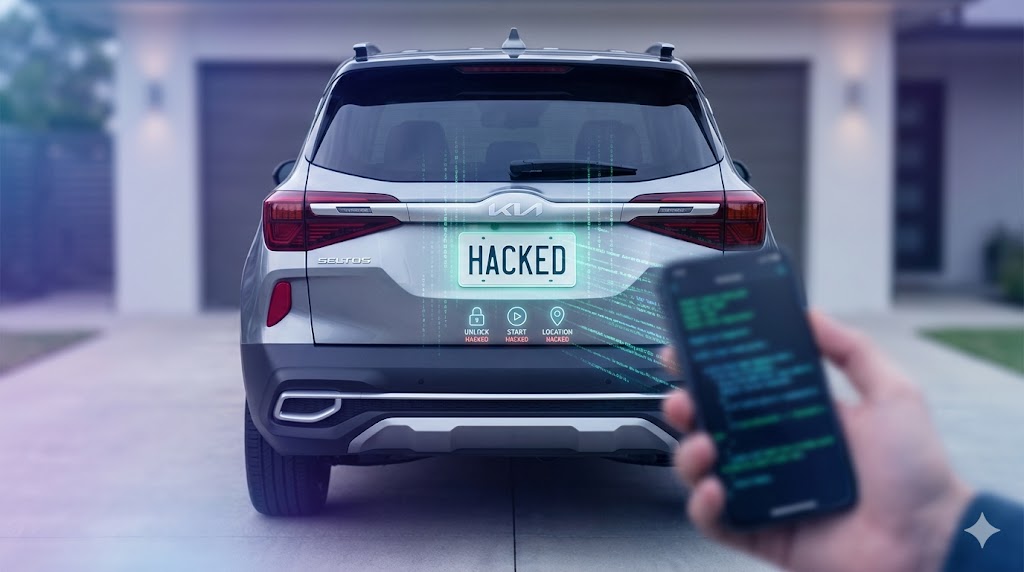
Imagine walking out of a grocery store, looking at your car, and realizing researchers demonstrated that flaws in Kia’s online systems could allow unauthorized access to certain connected vehicle functions after exploiting multiple backend vulnerabilities. Now, imagine they did all of this using nothing but the license plate bolted to your bumper. In September 2024, the illusion of automotive security was shattered when a team of cybersecurity researchers revealed a devastating vulnerability that allowed exactly this scenario across millions of Kia vehicles.
The transition to “software-defined vehicles” has turned our cars into rolling web browsers. As vehicles become more connected, some buyers are reconsidering ownership models and turning to Japan used car auctions, where vehicles are sourced directly from inspection-based bidding systems rather than software-heavy dealer ecosystems. and the consequences are terrifying. The 2024 Kia exploit proves that the incident highlighted how vulnerabilities in connected vehicle ecosystems can expose owners to privacy and security risks. waiting to be exploited by anyone with an internet connection.
The “Dealer” Backdoor: No Crowbar Required
In June 2024, a team of four security researchers—Sam Curry, Neiko Rivera, Justin Rhinehart, and Ian Carroll—discovered critical flaws not in the physical car itself, but in the Korean automaker’s web infrastructure. The researchers didn’t use complex radio relays to clone a key fob; they simply exploited textbook web application bugs on the owners.kia.com website and dealer portals.
By bypassing a poorly secured validation process, the researchers managed to register a fraudulent dealer account. Once inside this infrastructure, they gained access to an employee-only Application Programming Interface (API). This API acted as a master key, allowing them to translate any target car’s license plate directly into its unique Vehicle Identification Number (VIN).
While many buyers check VIN to verify a vehicle’s history before purchasing, this incident demonstrated how weaknesses in backend systems could allow attackers to misuse VIN-related information if proper security controls are not in place.
The Silent Takeover
Armed with the VIN, the researchers manipulated an HTTP request to compromise the backend system and generate a fraudulent authentication token. This allowed them to overwrite the legitimate owner’s email registration and silently add themselves as an invisible, secondary “owner” of the vehicle.
The most chilling aspect of this exploit? The silent nature of the attack. From the victim’s side, there was absolutely no notification that their vehicle had been accessed or that their permissions had been modified. Furthermore, the attacker could harvest highly sensitive personal information, including the victim’s name, phone number, email address, and physical address.
Total Remote Control in 30 Seconds
Once authenticated as the “owner,” the researchers had extensive access to connected vehicle features and connected functions. Within roughly 30 seconds of entering a license plate, they could execute remote commands to unlock doors, start or stop the engine, honk the horn, and passively track the vehicle’s precise GPS coordinates in real-time.
This was a catastrophic, ecosystem-wide failure. The vulnerability impacted almost any hardware-equipped Kia vehicle manufactured after 2013. Most alarmingly, the attack worked perfectly regardless of whether the owner even had an active Kia Connect subscription. Even if you chose to opt out of the “smart” features, the hardware was still active, listening, and vulnerable.
The API Crisis and the Stand for Analog Security
The 2024 Kia incident—which was thankfully patched in mid-August 2024 before malicious actors could deploy it at scale—exposes the fatal flaw in the modern automotive industry. Vehicles are no longer standalone machines; they are nodes in a massive, poorly secured web of APIs. When a simple authorization bug allows global remote control over physical multi-ton machines, the “smart” car revolution has clearly failed to prioritize basic human safety.
You cannot hack a mechanical linkage. You cannot execute an API exploit on a physical ignition cylinder. At Qualitex Trading Co. Ltd., we have seen exactly where this connected nightmare is leading, and we offer an alternative for buyers who prefer simpler vehicle architectures with fewer connected systems. As a trusted exporter of premium Japanese used cars, we specialize in delivering vehicles that prioritize mechanical sovereignty over digital vulnerability. We provide the world with legendary, reliable Japanese engineering that answers only to the driver in the seat—not a hacker with an HTTP request. Don’t let your license plate become a backdoor. Choose analog safety with Qualitex Trading.
Frequently Asked Questions
1. Who discovered the 2024 Kia remote hack?
A team of four security researchers led by Sam Curry, including Neiko Rivera, Justin Rhinehart, and Ian Carroll, uncovered the vulnerabilities.
2. How did the hackers target specific vehicles?
The researchers only needed the vehicle’s license plate number. They exploited an employee-only API on a compromised dealer portal to convert the license plate into the car’s Vehicle Identification Number (VIN).
3. What systems did the attackers compromise to get in?
They exploited flaws in the owners.kia.com website and the automaker’s dealer portal infrastructure, bypassing validation processes to generate a fraudulent authentication token.
4. What level of control did the hackers gain over the car?
Attackers could remotely execute commands to unlock the doors, start or stop the engine, honk the horn, and monitor the vehicle’s real-time GPS location.
5. Did the attack require the owner to have an active subscription?
No. The attack worked on hardware-equipped vehicles regardless of whether the owner was actively paying for a Kia Connect subscription.
6. Were the vehicle owners notified when their cars were hacked?
No. The researchers could silently add themselves as an invisible second user, and the legitimate owner received absolutely no notification that their vehicle’s permissions had been modified.
7. What personal data was exposed in this API breach?
The vulnerabilities allowed the attackers to harvest sensitive personal information, including the victim’s name, phone number, email address, and physical address.
8. How fast could an attacker hijack a car using this method?
Once the license plate was entered into the malicious tool, the attacker could gain control of key vehicle functions in roughly 30 seconds.
9. Which Kia vehicles were vulnerable to this exploit?
According to the security researchers, the vulnerabilities could be exploited to send commands to almost any Kia vehicle manufactured after 2013.
10. Why does Qualitex Trading Co. Ltd. recommend analog vehicles?
As a trusted exporter of used Japanese cars, Qualitex Trading recognizes that older vehicles generally present fewer remote attack opportunities because they lack the connected services found in many modern vehicles, ensuring the driver maintains true mechanical sovereignty.
Whether you’re looking for an older analog vehicle or a dependable daily driver, Japan car auctions offer access to thousands of inspected vehicles that combine value, reliability, and long-term ownership benefits.
Ready to Import Your Next Vehicle?
Qualitex Trading Japan provides direct access to over 100,000+ Japanese used cars at auction prices. We handle bidding, inspection, and global shipping.